Napoléon (1927)

- Directed by
- Abel Gance
- Genre
- drama film, silent film, biographical film
- Country
- Germany, France, Italy
- Runtime
- 5h 30m
- Rated
- 10
- Rating
- 7.8 of 10 from 221 voters
- Elsewhere
- IMDb

The catalogue in 3D
The film shelves have a room of their own that you can walk around in. The cat behind the counter is the AI Catbot, and they pick real films from the same catalogue when you tell them what you feel like watching. Nothing is for sale, here or in there. Go in from here and this film is already out on the counter, with more like it waiting on the shelf next to it.
How it feels
The film follows Napoleon from his childhood at a military school through his early involvement in the French Revolution. It focuses on his military and political rise during his younger years.
epicsweepingvisually ambitiousdramaticintimateinnovativehistorically chargedtriumphantfluid
What happens
Napoléon (on-screen title: Napoléon vu par Abel Gance, "Napoleon as seen by Abel Gance") is a 1927 French silent epic historical film, produced and directed by Abel Gance, that tells the story of Napoleon's early years. The only film to use Polyvision (for the finale), it is recognised as a masterwork of fluid camera motion, produced in a time when most camera shots were static. Many innovative techniques were used to make the film, including fast cutting, extensive close-ups, a wide variety of hand-held camera shots, location shooting, point of view shots, multiple-camera setups, multiple exposure, superimposition, underwater camera, kaleidoscopic images, film tinting, split screen and mosaic shots, multi-screen projection, and other visual effects. A revival of Napoléon in the mid-1950s influenced the filmmakers of the French New Wave. The film used the Keller-Dorian cinematography for its color sequences. The film begins in Brienne-le-Château with youthful Napoleon attending military school where he manages a snowball fight like a military campaign, yet he suffers the insults of other boys. It continues a decade later with scenes of the French Revolution and Napoleon's presence at the periphery as a young army lieutenant. He returns to visit his family home in Corsica but politics shift against him and put him in mortal danger. He flees, taking his family to France. Serving as an officer of artillery in the Siege of Toulon, Napoleon's genius for leadership is rewarded with a promotion to brigadier general. Jealous revolutionaries imprison Napoleon but then the political tide turns against the Revolution's own leaders. Napoleon leaves prison, forming plans to invade Italy. He falls in love with the beautiful Joséphine de Beauharnais. The emergency government charges him with the task of protecting the National Assembly. Succeeding in this he is promoted to Commander-in-Chief of the Army of the Interior, and he marries Joséphine. He takes control of the army which protects the French–Italian border and propels it to victory in an invasion of Italy. Gance planned for Napoléon to be the first of six films about Napoleon's career, a chronology of great triumph and defeat ending in Napoleon's death in exile on the island of Saint Helena. After the difficulties encountered in making the first film, Gance realised that the costs involved would make the full project impossible. Napoléon was first released in a gala at the Palais Garnier (then the home of the Paris Opera) on 7 April 1927. The film had been screened in only eight European cities when Metro-Goldwyn-Mayer bought the rights to it, but after screening it in London, it was cut drastically in length, and only the central panel of the three-screen Polyvision sequences was retained before it received a limited release in the United States. There, the film was indifferently received at a time when talkies were just starting to appear. The film was restored in 1980 after twenty years' work by silent film historian Kevin Brownlow, with further restoration done under his supervision in 2016. A new restoration of the film, supervised by Georges Mourier, premiered in France in July 2024. (from Wikipedia, CC BY-SA)
More like this
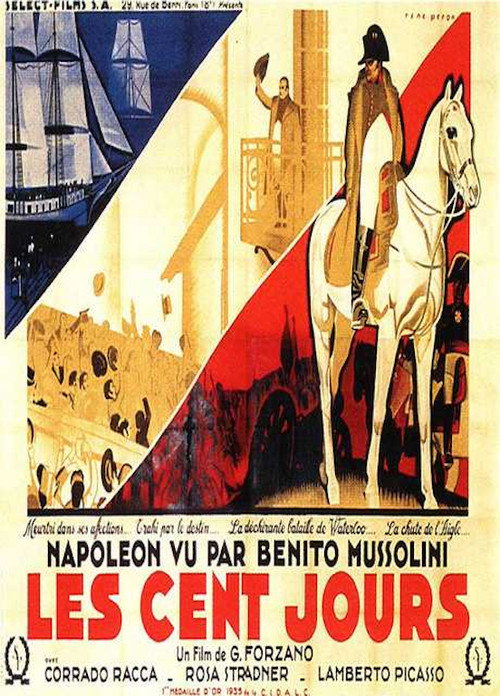 Campo di Maggio (1935)
 Napoléon (1955)
 For Napoleon and France (1914)
 Austerlitz (1960)
 Napoleon at Saint Helena (1929)
 Hundred Days (1935)
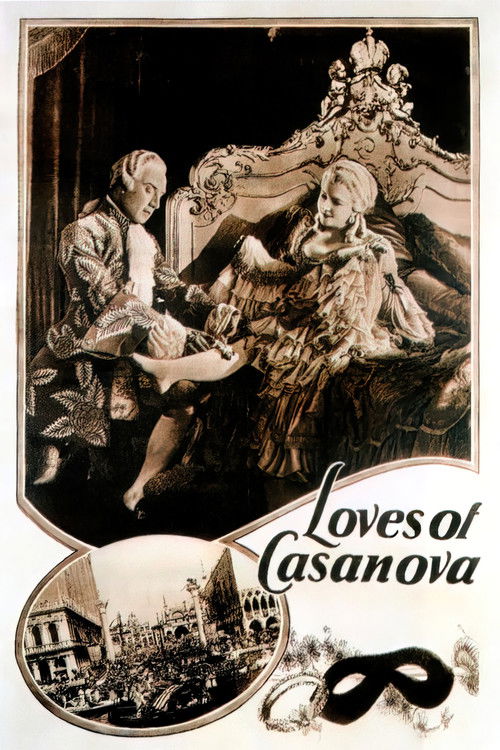 The Loves of Casanova (1927)
 The Prince's Child (1927)
- More like this film, on a shelf you can walk up to.It's the lit case on the top shelf.