The Life and Death of 9413: a Hollywood Extra (1928)

- Original title
- The Life and Death of 9413: A Hollywood Extra
- Directed by
- Robert Florey
- Genre
- drama film, silent film
- Country
- United States
- Runtime
- 14 min
- Rating
- 6.6 of 10 from 54 voters
- Elsewhere
- IMDb

The catalogue in 3D
The film shelves have a room of their own that you can walk around in. The cat behind the counter is the AI Catbot, and they pick real films from the same catalogue when you tell them what you feel like watching. Nothing is for sale, here or in there. Go in from here and this film is already out on the counter, with more like it waiting on the shelf next to it.
How it feels
A man arrives in Hollywood wanting to be an actor. Studio executives treat him like an object, marking a number on his forehead as he sinks into obscurity.
experimentalsurrealbleakfast-paceddisorientingmelancholicstylizedsatirical
What happens
The Life and Death of 9413: a Hollywood Extra is a 1928 American silent experimental short film co-written and co-directed by Robert Florey and Slavko Vorkapić. Considered a landmark of American avant-garde cinema, it tells the story of a man (played by Jules Raucourt) who comes to Hollywood with dreams of becoming a star; he fails and becomes dehumanized, with studio executives reducing him to the role of an extra and writing the number "9413" on his forehead. The film has abrupt cuts, rapid camera movement, extensive superimposition, dim lighting, and twisted shapes and forms at disorienting angles. Filmed on a budget of only $97 ($1,819 in today's (2024+/-) dollars), it includes a combination of close-ups of live actors and long shots of miniature sets constructed from cardboard, paper cubes, tin cans, cigar boxes, and toy trains. With no access to Hollywood studios or equipment, most of the film was made in the filmmakers' homes (their walls painted black to provide a background). The story was inspired by Florey's own experiences in Hollywood and George Gershwin's Rhapsody in Blue. It was one of the first films shot by Gregg Toland, who was later acclaimed for his work on such films as The Grapes of Wrath (1939) and Citizen Kane (1941). The film is a satire of Hollywood's social conditions, practices and ideologies, and the film industry's alleged mistreatment of actors. Douglas Fairbanks assisted with its development, and Charlie Chaplin and Joseph M. Schenck helped to promote it. Unlike most experimental films, it received a wide release by FBO Pictures Corporation in more than 700 theaters in North America and Europe. The film has been well received by contemporary and present-day critics; according to film historian Brian Taves, "More than any other American film, it initiated the avant-garde in this country". In 1997, it was selected for preservation by the National Film Registry. Florey co-wrote and directed Hollywood Boulevard (1936), a lighter version of the film. (from Wikipedia, CC BY-SA)
More like this
 The Last Moment (1928)
 The Crowd (1928)
 The Head Man (1928)
 Blindfold (1928)
 The Red Mark (1928)
 The Stronger Will (1928)
 The Scarlet Lady (1928)
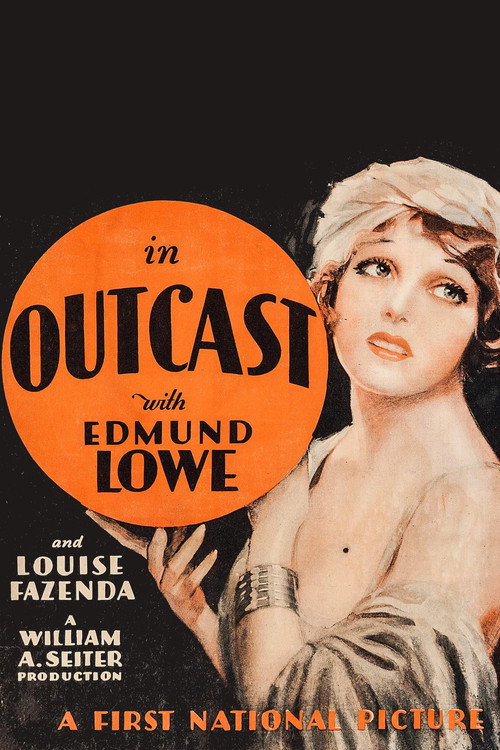 Outcast (1928)
- More like this film, on a shelf you can walk up to.It's the lit case on the top shelf.