Kalidas (1931)
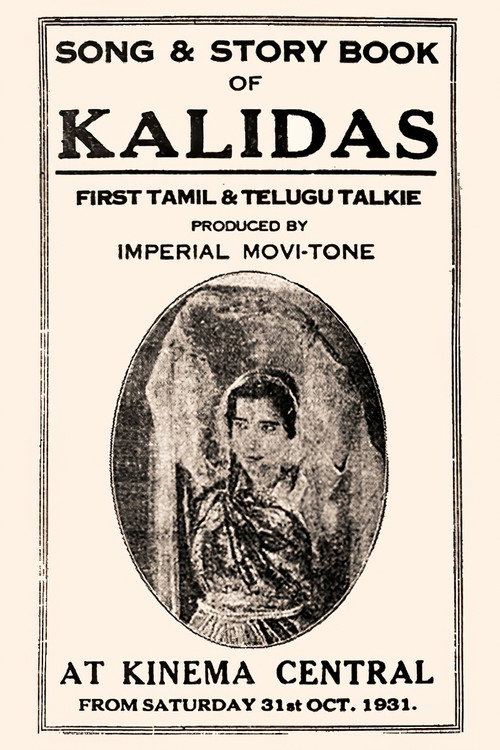
- Directed by
- H. M. Reddy
- Genre
- musical film, biographical film
- Country
- India
- Rating
- 7.0 of 10 from 1 voters
- Elsewhere
- IMDb
The catalogue in 3D
The film shelves have a room of their own that you can walk around in. The cat behind the counter is the AI Catbot, and they pick real films from the same catalogue when you tell them what you feel like watching. Nothing is for sale, here or in there. Go in from here and this film is already out on the counter, with more like it waiting on the shelf next to it.
How it feels
Kalidas is about the life of the ancient Sanskrit poet Kalidasa, showing him as a central figure in a mythological story. It was India's first sound film in the Tamil and Telugu languages, mixing songs from different eras into the narrative.
historicalmusicalpioneeringmythologicalfolk-inflectedpatchyarchival
What happens
Kalidas (pronounced [kaːɭidaːs] transl. The Servant of Kali) is a 1931 Indian biographical film directed by H. M. Reddy and produced by Ardeshir Irani. It is notable for being the first sound film in the Tamil and Telugu languages, and the first sound film to be made in a Dravidian language. It was based on the life of the Sanskrit poet Kalidasa; it featured P. G. Venkatesan in the title role and T. P. Rajalakshmi as the female lead, with L. V. Prasad, Thevaram Rajambal, T. Susheela Devi, J. Sushila, and M. S. Santhanalakshmi in supporting roles. Kalidas had dialogues in Telugu, with some Tamil songs featured in the beginning, middle, and end, along with some additional dialogue in Hindi. Despite its mythological theme, the film featured songs from much later time periods, such as the compositions of Carnatic musician Tyagaraja, publicity songs of the Indian National Congress, and songs about Mahatma Gandhi and the Indian independence movement. The sound was recorded using German-made technology. Kalidas was shot in Bombay on the sets of India's first sound film Alam Ara (1931) and was completed in eight days. Kalidas was released with high expectations on 31 October 1931, coinciding with Diwali day. It was the only South Indian film to be produced and released that year. Despite numerous technical flaws, it received critical acclaim, with praise for Rajalakshmi's singing performance, and became a major commercial success. The success of Kalidas spawned other films based upon Kalidasa, including Mahakavi Kalidasa (1955), Mahakavi Kalidasu (1960), and Mahakavi Kalidas (1966). In addition to its commercial success, Kalidas was a major breakthrough for Rajalakshmi's career, and made her a bankable singing star. Because no print, gramophone record, or songbook of the film is known to survive, it is a lost film. (from Wikipedia, CC BY-SA)
More like this
 Mahakavi Kalidasu (1960)
 Mahakavi Kalidasa (1955)
 Mahakavi Kalidas (1966)
 Mahakavi Kalidas (1942)
 தமிழ்த் திரைப்படங்களின் பட்டியல், 1931 (1931)
 Kaviratna Kalidasa (1983)
 Dada Lakhmi (2022)
 Bhoja Kalidasa (1940 film) (1940)
- More like this film, on a shelf you can walk up to.It's the lit case on the top shelf.