Alam Ara (1931)

- Original title
- आलम आरा
- Directed by
- Ardeshir Irani
- Genre
- drama film, fantasy film, romantic drama
- Country
- British Raj
- Runtime
- 2h 04m
- Rating
- 6.5 of 10 from 2 voters
- Elsewhere
- IMDb

The catalogue in 3D
The film shelves have a room of their own that you can walk around in. The cat behind the counter is the AI Catbot, and they pick real films from the same catalogue when you tell them what you feel like watching. Nothing is for sale, here or in there. Go in from here and this film is already out on the counter, with more like it waiting on the shelf next to it.
How it feels
A king has two wives. A fakir predicts the first wife will have a son who will die when he turns 18 unless his mother finds a special necklace. Meanwhile, the king imprisons a general when he learns the general and his second wife are in love.
historicalromanticdramaticfantasticalsoap-operafairy-taletragic
What happens
Alam Ara (transl. Ornament of the World) is a 1931 Indian historical fantasy film directed and produced by Ardeshir Irani. It revolves around a king and his two wives, Navbahaar and Dilbahaar, who are childless; soon, a fakir (Wazir Muhammad Khan) tells the king that the former wife will give birth to a boy, later named Qamar (Master Vithal), but the child will die following his 18th birthday if Navbahaar cannot find the necklace he asks for. Meanwhile, the king finds out that Dilbahaar has fallen for the senapati Adil (Prithviraj Kapoor), leading the king to arrest him and evict his pregnant wife, who later gives birth to Alam Ara (Zubeida). Irani was inspired to make Alam Ara after watching the 1929 American part-talkie Show Boat. The story was adapted from the Bombay-based dramatist Joseph David's play of the same name. Made on a budget of ₹40,000 (equivalent to ₹12 million or US$130,000 in 2023), principal photography was handled by Adi M. Irani within four months in Bombay. Because the studio was located near a railway track, it was filmed mostly during the nighttime to avoid noise from the active trains. Following the filming, Ardeshir Irani finished the sound recording, using the single-system recording. Firozshah Mistry and B. Irani served as the music directors. Alam Ara was released on 14 March 1931 and performed well at the box office. Critics were appreciative, with the performance and songs getting the most attention, though there was some criticism of the sound recording. The film was also widely considered a major breakthrough for the Indian film industry and Ardeshir Irani's career with its status as the country's first sound film. Although no print or gramophone record of the film is known to survive, making it a lost film, surviving artefacts include its stills and posters. In 2017, the British Film Institute declared it as the most important of any lost films produced in India. (from Wikipedia, CC BY-SA)
More like this
 Karma (1933)
 Bharati Balak (1931)
 Dil Ki Rani (1947)
 Son of India (1931)
 Chirakumar Sabha (1932)
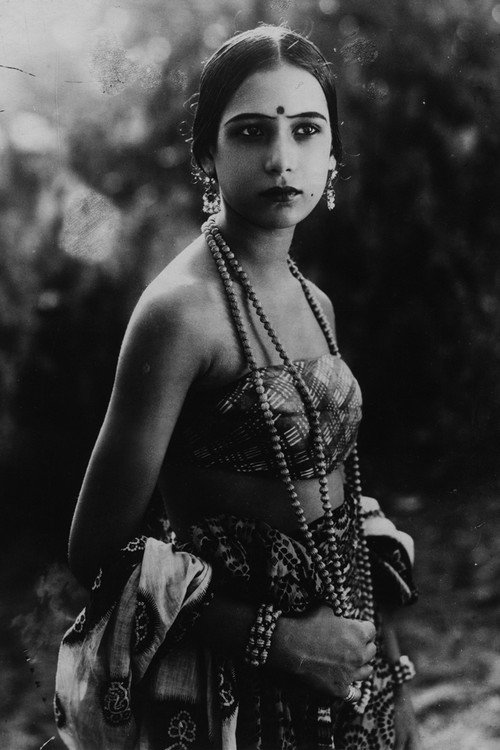 Durgesh Nandini (1927)
 Subah Ka Sitara (1932)
 Laila Majnu (1931)
- More like this film, on a shelf you can walk up to.It's the lit case on the top shelf.