Flüchtlinge (1933)

- Directed by
- Gustav Ucicky
- Genre
- drama film, adventure film, war film, propaganda film
- Country
- Germany
- Runtime
- 1h 21m
- Rating
- 6.2 of 10 from 4 voters
- Elsewhere
- IMDb

The catalogue in 3D
The film shelves have a room of their own that you can walk around in. The cat behind the counter is the AI Catbot, and they pick real films from the same catalogue when you tell them what you feel like watching. Nothing is for sale, here or in there. Go in from here and this film is already out on the counter, with more like it waiting on the shelf next to it.
How it feels
In 1928, Volga German refugees are persecuted by Bolsheviks on the Sino-Russian border in Manchuria. A German leader rescues them by demanding obedience and embodying nationalist ideals.
melodramatictenseheroicnationalisticpropagandisticseriousstirring
What happens
Refugees (German: Flüchtlinge) is the 1933 German drama film, directed by Gustav Ucicky and starring Hans Albers, Käthe von Nagy, and Eugen Klöpfer. It depicts Volga German refugees persecuted by the Bolsheviks on the Sino-Russian border in Manchuria in 1928. The screenplay was written by Gerhard Menzel and was based on his own novel of the same title. It was shot at the Babelsberg Studios with sets designed by the art directors Robert Herlth and Walter Röhrig. A separate French-language version At the End of the World was also produced, with Käthe von Nagy appearing alongside a different cast. It was the first movie to be awarded an NS-Staatspreis prize, and Goebbels praised it as among those films that, while they did not explicitly cite National Socialist principles, nevertheless embodied its spirit, a new film reflecting the ideal of their national revolution. The refugees are rescued by a heroic German leader much like the Führer; the symbolism is obviously intended to emulate Adolf Hitler. He is disgusted by "November Germany", and devotes himself to the ideal of "true Germany". He off-handedly disposes of some refugees as worthless, and demands complete obedience from all others. The death of a boy deeply devoted to him moves him, as dying for a cause is something he would wish for himself, in keeping with Nazi glorification of heroic death. Their Communist persecutors are portrayed simply as brutal murderers, typical of works prior to the Molotov–Ribbentrop Pact (and again after its breach). The film was shown for some time after the pact, owing to bureaucratic oversight, complicating the efforts of Nazi propaganda. The movie is mostly set in the city of Harbin, in what was at the time the Republic of China. (from Wikipedia, CC BY-SA)
More like this
 Morgenrot (1933)
 Hans Westmar (1933)
 Hitlerjunge Quex (1933)
 The Deserter (1933)
 Jumping Into the Abyss (1933)
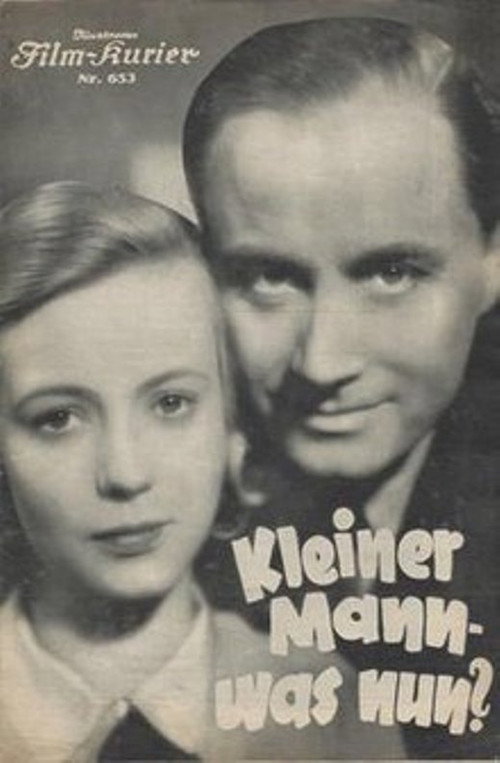 Little Man, What Now? (1933)
 S.A.-Mann Brand (1933)
 The Patriots (1933)
- More like this film, on a shelf you can walk up to.It's the lit case on the top shelf.