Lava Kusa (1934)

- Original title
- లవ కుశ
- Directed by
- C. Pullaiah
- Genre
- history, family, drama, music
- Country
- British Raj
- Runtime
- 2h 45m
- Rating
- 8.0 of 10 from 1 voters
- Elsewhere
- IMDb
The catalogue in 3D
The film shelves have a room of their own that you can walk around in. The cat behind the counter is the AI Catbot, and they pick real films from the same catalogue when you tell them what you feel like watching. Nothing is for sale, here or in there. Go in from here and this film is already out on the counter, with more like it waiting on the shelf next to it.
How it feels
This film tells the Ramayana story of Sita who lives in the forest after leaving Rama. She gives birth to twin sons Lava and Kusa who later confront Rama not knowing he is their father.
mythologicaldevotionaltraditionalsong-filleddramaticfamily-orientedepic
What happens
Lava Kusa is a 1934 Telugu-language Hindu mythological film directed by C. Pullayya and produced by Motilal Chamaria under the East India Film Company. The film is based on the play Lava Kusa, written by K. Subrahmanya Sastry, and marks an important milestone in early Telugu cinema. It was one of the first Telugu films to feature recorded songs, following the trend set by Sati Savitri (1933). All the songs in Lava Kusa were well received, contributing to its success. The film narrates the Ramayana story of Sita, who, after retiring to the forest, gives birth to twin sons, Lava and Kusa. Unaware that Rama is their father, the twins later confront him. The film was a major hit and ran in some theatres for over a year. It marked the acting debut of singer Sriranjani. It was also one of the first Telugu films to have a wide release in rural areas of Andhra Pradesh. C. Pullayya, in collaboration with his son C. S. Rao, remade Lava Kusa in 1963, featuring N. T. Rama Rao and Anjali Devi in the lead roles. (from Wikipedia, CC BY-SA)
More like this
 Lavakusa (1934)
 Seeta (1934)
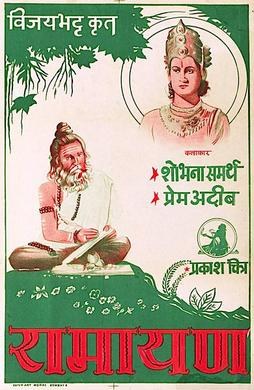 Ramayan (1954)
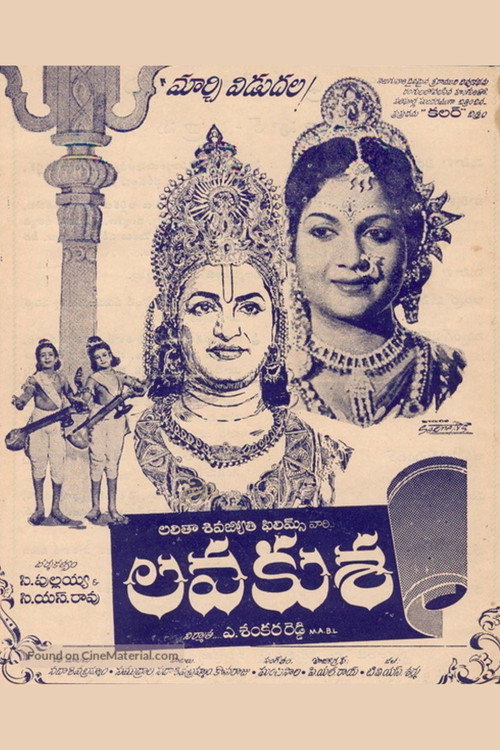 Lava Kusha (1963)
 Seeta Kalyanam (1934)
 Ram Rajya (1967)
 Ramayanam (1932)
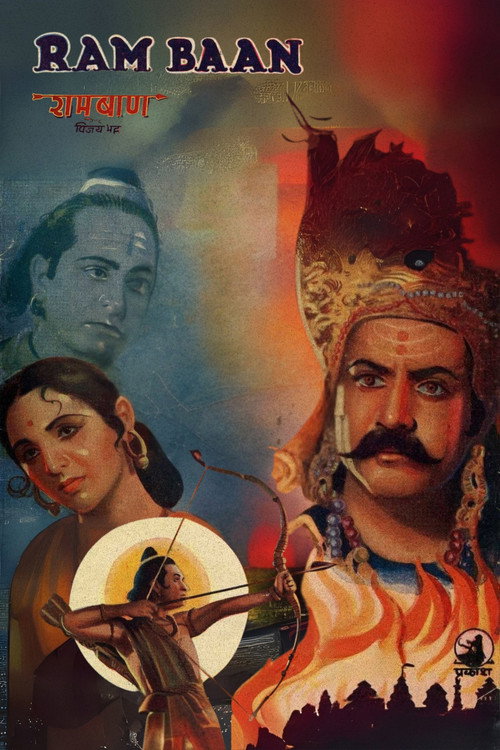 Ram Rajya (1948)
- More like this film, on a shelf you can walk up to.It's the lit case on the top shelf.