Sathi Leelavathi (1936)

- Original title
- சதி லீலாவதி
- Directed by
- Ellis R. Dungan
- Genre
- drama film
- Country
- British Raj
- Runtime
- 3h 20m
- Rated
- U
- Rating
- 8.0 of 10 from 1 voters
- Elsewhere
- IMDb
The catalogue in 3D
The film shelves have a room of their own that you can walk around in. The cat behind the counter is the AI Catbot, and they pick real films from the same catalogue when you tell them what you feel like watching. Nothing is for sale, here or in there. Go in from here and this film is already out on the counter, with more like it waiting on the shelf next to it.
How it feels
A man from Madras is tricked into drinking alcohol and thinks he killed his friend. He runs away to Ceylon, leaving his wife and daughter in poverty.
melodramaticold-fashionedearnesttensesadcautionarymoralisticpoverty-stricken
What happens
Sathi Leelavathi ( transl. Leelavathi, the Chaste Wife) is a 1936 Indian Tamil-language drama film directed by Ellis R. Dungan. The screenplay by Madras Kandaswamy Mudaliar is based on S. S. Vasan's novel of the same name, which had been serialised in 1934. M. K. Radha stars as Krishnamurthy, a man from Madras, who is lured into drinking alcohol by an acquaintance. Believing he murdered his friend in a drunken stupor, Krishnamurthy flees to Ceylon while his wife and daughter, played by M. R. Gnanambal and M. K. Mani respectively, are reduced to poverty. T. S. Balaiah, M. G. Ramachandran, M. V. Mani and P. Nammalvar appear in supporting roles. A. N. Marudachalam Chettiar initially wanted to produce a film version of the Madurai Original Boys Company (MOBC) play Pathi Bhakthi, but realised an adaptation was already being made. Chettiar then learnt about Vasan's novel, which had a similar plot and obtained the rights to make a film version. Sathi Leelavathi was Dungan's directorial debut and the film-acting debuts of Radha, Balaiah, Ramachandran and K. A. Thangavelu. It was N. S. Krishnan's first film appearance, but his second release. The film was mostly shot at Vel Pictures Studio in Madras. D. T. Telang and V. J. Shave were the cinematographers, the Sharma brothers were the composers and the film was co-edited by Dungan and Sircar. Sathi Leelavathi explores themes of temperance, social reform, the Gandhian concept of selfless service and the plight of labourers. It was one of the earliest Tamil films to be involved in a plagiarism controversy; the MOBC accused Chettiar and Mudaliar of plagiarising their play. The case was resolved after Vasan testified that both the play and the novel were based on Danesbury House, an 1860 novel written by Ellen Wood, so neither party could claim originality. The film was released in theatres on 1 February 1936 and became a commercial success, making Dungan a sought-after director. Several features of his direction, including shooting by schedule, camera mobility, cabaret dances and less-theatrical acting, became staples of Tamil cinema. No complete print of the film is known to survive, making it a partially lost film. (from Wikipedia, CC BY-SA)
More like this
 Grama Kanya (1936)
 Pujarin (1936)
 Seemanthini (1936)
 Janmabhoomi (1936)
 Samsara Nauka (1936)
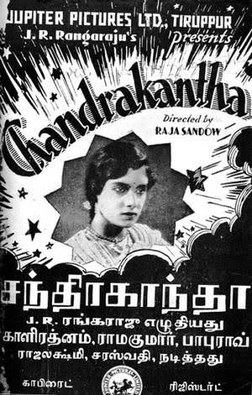 Chandrakantha (1936)
 Shaher Ka Jadoo (1934)
 Pathi Bhakthi (1936)
- More like this film, on a shelf you can walk up to.It's the lit case on the top shelf.