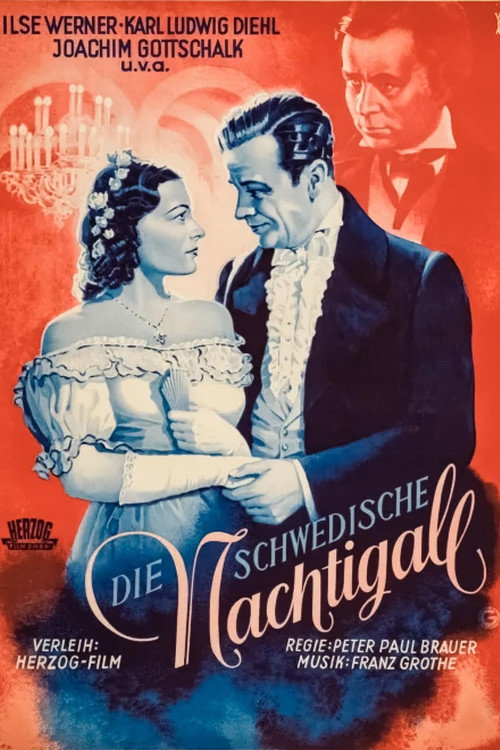
The Swedish Nightingale (1941)
- Original title
- Die schwedische Nachtigall
- Directed by
- Peter Paul Brauer
- Genre
- drama film, musical film
- Country
- Nazi Germany, Germany
- Runtime
- 1h 36m
- Rating
- 7.5 of 10 from 2 voters
- Elsewhere
- IMDb
The catalogue in 3D
The film shelves have a room of their own that you can walk around in. The cat behind the counter is the AI Catbot, and they pick real films from the same catalogue when you tell them what you feel like watching. Nothing is for sale, here or in there. Go in from here and this film is already out on the counter, with more like it waiting on the shelf next to it.
How it feels
This film is a fictional romance between the writer Hans Christian Andersen and the opera singer Jenny Lind. It takes place in nineteenth century Copenhagen and follows their relationship.
romanticwhimsicalnostalgiclightheartedold-fashionedtendersentimental
What happens
The Swedish Nightingale (German: Die schwedische Nachtigall) is a 1941 German musical film directed by Peter Paul Brauer and starring Ilse Werner (singing sequences with Erna Berger's voice), Karl Ludwig Diehl, and Joachim Gottschalk. The film is based on a play by Friedrich Forster-Burggraf set in nineteenth century Copenhagen. It portrays a romance between the writer Hans Christian Andersen and the opera singer Jenny Lind, the "Swedish Nightingale" of the title. It was shot at the Terra Studios in Berlin. The film's sets were designed by the art directors Robert Herlth and Heinrich Weidemann. Made on a budget of around one and half million Reichsmarks, it was a major commercial success on its release across Europe. At the time when the film was made, Germany was keeping Denmark under military occupation but attempting a relatively conciliatory attitude towards the occupied Danes. Germany was also making an effort to keep good relations with the neutral Sweden. The theme of the film – made at a time when Joseph Goebbels' Propaganda Ministry kept tight control of the German film industry – fit well with these policy aims. (from Wikipedia, CC BY-SA)
More like this
 Jenny Lind (1931)
 Tror du jeg er født i går! (1941)
 You Only You (1941)
 The Girl from Fano (1941)
 Niels Pind og hans dreng (1941)
 Peter Andersen (1941)
 Her First Experience (1939)
 Tanz mit dem Kaiser (1941)
- More like this film, on a shelf you can walk up to.It's the lit case on the top shelf.