Moestika dari Djemar (1941)

- Directed by
- Jo An Djan
- Genre
- drama
- Country
- Indonesia
- Elsewhere
- IMDb

The catalogue in 3D
The film shelves have a room of their own that you can walk around in. The cat behind the counter is the AI Catbot, and they pick real films from the same catalogue when you tell them what you feel like watching. Nothing is for sale, here or in there. Go in from here and this film is already out on the counter, with more like it waiting on the shelf next to it.
How it feels
This black and white film from the Dutch East Indies tells a fantastical story inspired by the Arabian Nights. A young girl makes her feature film debut in this adventure about a magical item.
old-fashionedfantasticallightwhimsicalnostalgicadventuroussimpledatedstorybook-like
What happens
Moestika dari Djemar (Perfected Spelling: Mustika dari Djemar) is a 1941 film from the Dutch East Indies (now Indonesia). Multiple modern sources also use the incorrect spelling Moestika dari Djenar, but contemporary sources uses an "m". Moestika dari Djemar was directed by Jo An Djan and produced by Jo Kim Tjan for Populair's Film. The black-and-white film starred Dhalia, Rd Mochtar, Rd Kosasie, Eddy T Effendi, and 9-year-old Djoeriah (in her feature film debut). The studio had been established the preceding year and already released a single film, Garoeda Mas, the year before. The film was produced shortly following Ratna Moetoe Manikam, released with The Teng Chun's Java Industrial Film, and took similar source material: as with Moestika dari Djemar, it was drawn from the One Thousand and One Arabian Nights, though the films were taken from different stories. Other contemporary works adapted from Nights were Tan's Film's Aladin and Koeda Sembrani; neither of the latter films were completed when the Japanese occupation began in 1942. Moestika dari Djemar was shown as early as 8 January 1942, playing in Cirebon. By February it had reached Surabaya, in eastern Java. It was targeted at audiences of all ages and advertised "brilliant costumes – mysticism – adventure and romance". The film is likely lost. The American visual anthropologist Karl G. Heider writes that all Indonesian films from before 1950 are lost. However, JB Kristanto's Katalog Film Indonesia (Indonesian Film Catalogue) records several as having survived at Sinematek Indonesia's archives, and Biran writes that several Japanese propaganda films have survived at the Netherlands Government Information Service. (from Wikipedia, CC BY-SA)
More like this
 Tjioeng Wanara (1941)
 Poesaka Terpendam (1941)
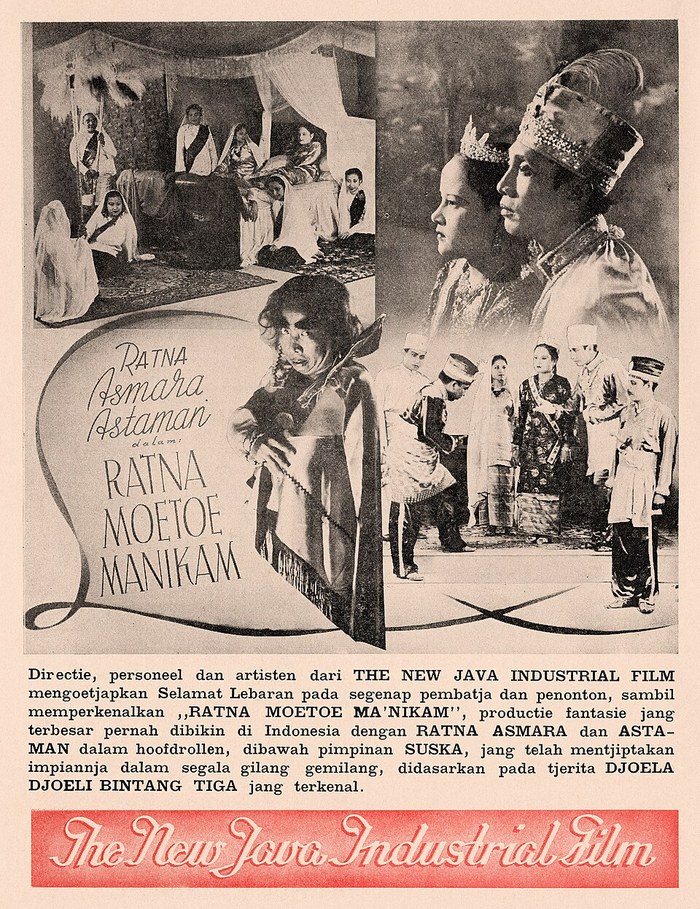 Ratna Moetoe Manikam (1941)
 Ikan Doejoeng (1941)
 Asmara Moerni (1941)
 Pantjawarna (1941)
 Poetri Rimba (1941)
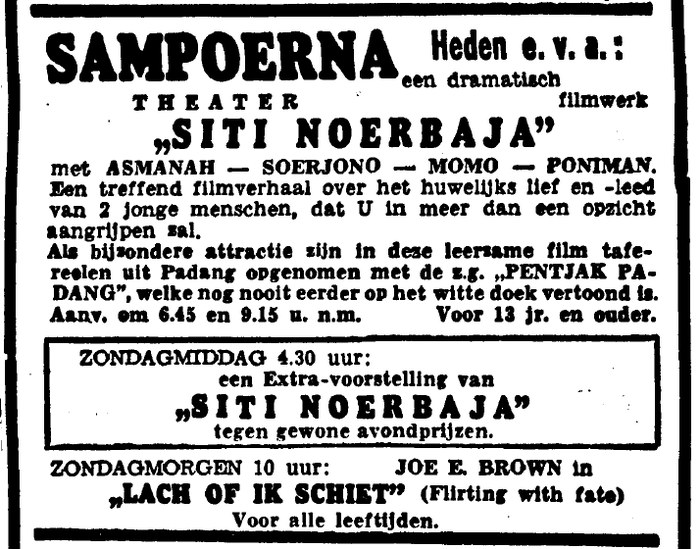 Siti Noerbaja (1941)
- More like this film, on a shelf you can walk up to.It's the lit case on the top shelf.