The Soviet Paradise (1942)

- Directed by
- Friedrich Albat
- Genre
- propaganda film
- Country
- Nazi Germany
- Elsewhere
- IMDb
The catalogue in 3D
The film shelves have a room of their own that you can walk around in. The cat behind the counter is the AI Catbot, and they pick real films from the same catalogue when you tell them what you feel like watching. Nothing is for sale, here or in there. Go in from here and this film is already out on the counter, with more like it waiting on the shelf next to it.
How it feels
This Nazi propaganda film from 1942 aims to justify war against the Soviet Union by depicting it as a place of poverty, misery, and brutality under Jewish Bolshevik rule. It uses graphic images of executions and hung children to spread hatred and fear.
propagandistichostilehatefulfear-mongeringmanipulativedisturbinggraphicjingoisticdark
What happens
The Soviet Paradise (German original title "Das Sowjet-Paradies") was the name of an exhibition and a propaganda film created by the Department of Film of the propaganda organisation (Reichspropagandaleitung) of the German Nazi Party (NSDAP), and was displayed in the larger cities of the Reich and occupied countries: Vienna, Prague, Berlin and others. Its goal was to show "poverty, misery, depravity and need" of the nations in the Soviet Union under "Jewish Bolshevist" rule and thus to justify the war against the Soviet Union. The accompanying guide for the exhibition noted, "The present Soviet state is nothing other than the realization of that Jewish invention". The exhibition included entire households with its contents, transported from the Eastern Front, on display. The exhibition contained images of firing-squads and bodies of young girls, some still children, who had been hung and were dangling from ropes. There was also a captured Soviet KV-2 Kliment Voroshilov tank in front of the entrance. From 8 May to 21 June 1942, the exhibition was in the Lustgarten in Berlin and according to official information 1.3 million people visited the show. The Berlin exhibition was opened with a large parade and a speech by the State Secretary of the Reich Ministry of Propaganda, Leopold Gutterer, in front of the exhibition hall. On May 18 a Jewish-Communist resistance group called "Baum-Group" organized an arson attack, which although it only caused minor damage to the exhibits, was deeply embarrassing to the regime. Herbert Baum, Marianne Baum, and over 30 other people were arrested and executed. The exhibition also attracted the attention of members of the Red Orchestra resistance group who affixed posters advertising the event with their own anti-Nazi stickers ( "Permanent Exhibition. The Nazi Paradise. War, Hunger, Lies, Gestapo. How much longer?"). It was an action that led to the arrest and execution of Helmut Himpel and Maria Terwiel. Unfortunately for these anti-Nazi resistance groups one of the main sponsors of the exhibition Reinhard Heydrich was assassinated in Prague at the end of May 1942. The assassination of Reinhard Heydrich caused an increase in Nazi reactions to any perceived resistance and vastly increased the retributions on any resistor and their associates, with Berlin Jews a particular focus of these attacks. As well as the glossy brochure, a short propaganda film was created to supplement the exhibition. A series of postcards was also created and these were geographically franked as the exhibition moved around the Reich starting in Vienna (13 December 1941) and ending in Essen (30 October 1942), via Prague, Berlin and Hamburg. (from Wikipedia, CC BY-SA)
More like this
 The Red Terror (1942)
 5 June (1942)
 Berlin Correspondent (1942)
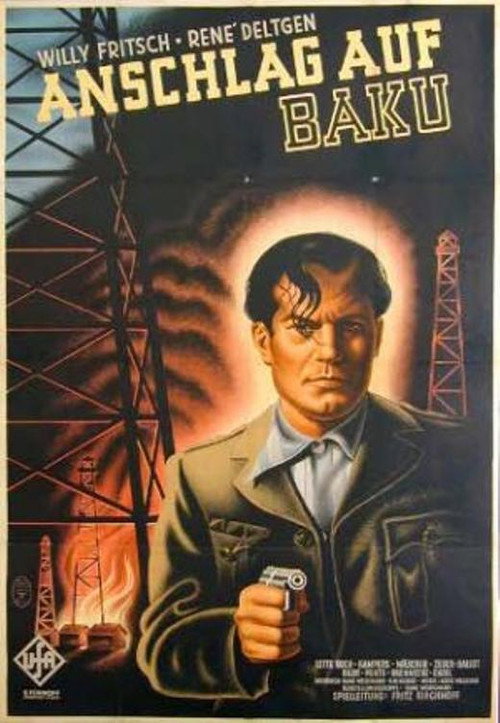 Attack on Baku (1942)
 The Murderers are Coming (1942)
 Boyevoy kinosbornik 11 (1942)
 The Big Blockade (1942)
 A Day of War (1942)
- More like this film, on a shelf you can walk up to.It's the lit case on the top shelf.