Japanese Relocation (1942)

- Directed by
- Milton Stover Eisenhower
- Genre
- propaganda film
- Country
- United States
- Runtime
- 10 min
- Rating
- 5.7 of 10 from 3 voters
- Elsewhere
- IMDb
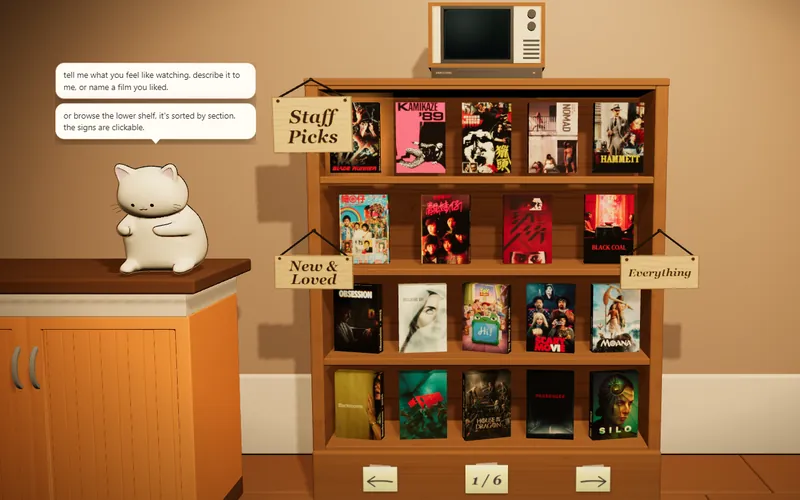
The catalogue in 3D
The film shelves have a room of their own that you can walk around in. The cat behind the counter is the AI Catbot, and they pick real films from the same catalogue when you tell them what you feel like watching. Nothing is for sale, here or in there. Go in from here and this film is already out on the counter, with more like it waiting on the shelf next to it.
How it feels
This short film from the US government explains and defends the forced relocation of Japanese Americans from the West Coast during World War II. It argues the removal was a necessary security measure and portrays it as a voluntary and humane process.
officialpersuasivedryclinicaldatedjustifyingpropagandisticinstructional
What happens
Japanese Relocation is a 1942 short film produced by the U.S. Office of War Information and distributed by the War Activities Committee of the Motion Picture Industry. It is a propaganda film, justifying and explaining Japanese American internment on the West Coast during World War II. It is narrated by Milton Eisenhower. The film starts by asserting that, while many Japanese-Americans were loyal, in early 1942 the West Coast was a potential combat zone, and the government did not know what the Japanese population would do if the US were invaded. Furthermore, the film noted that there were Japanese-American communities near militarily significant sites, such as shipyards and air bases. So, the film states, the Japanese were democratically and humanely evacuated to relocation centers in the desert. The film also states that most Japanese went voluntarily, and felt that it was a sacrifice they should make as loyal citizens. (from Wikipedia, CC BY-SA)
More like this
 A Challenge to Democracy (1944)
 Manpower (1942)
 Ring of Steel (1942)
 The Price of Victory (1942)
 It's Everybody's War (1942)
 Menace of the Rising Sun (1942)
 Conquer by the Clock (1942)
 A Letter from Bataan (1942)
- More like this film, on a shelf you can walk up to.It's the lit case on the top shelf.