The Arm Behind the Army (1942)

- Genre
- propaganda film
- Country
- United States
- Runtime
- 10 min
- Rating
- 9.0 of 10 from 1 voters
- Elsewhere
- IMDb
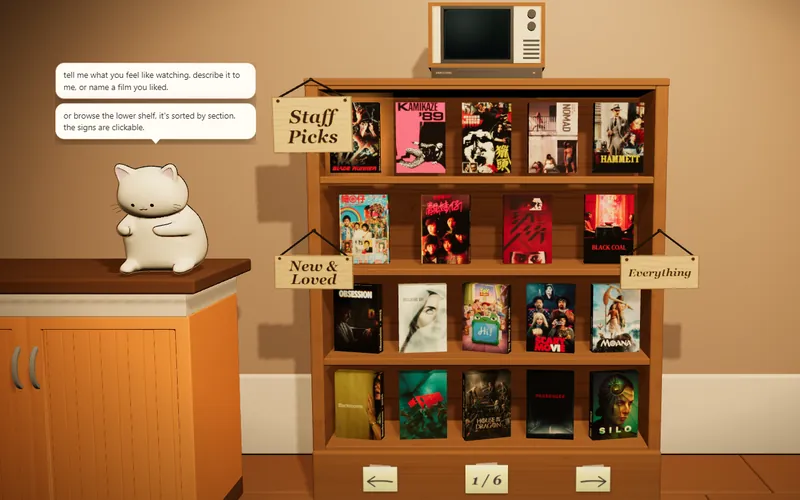
The catalogue in 3D
The film shelves have a room of their own that you can walk around in. The cat behind the counter is the AI Catbot, and they pick real films from the same catalogue when you tell them what you feel like watching. Nothing is for sale, here or in there. Go in from here and this film is already out on the counter, with more like it waiting on the shelf next to it.
How it feels
This film was made by the US Army to motivate American factory workers and citizens to support wartime production. It uses historical examples to argue that American industry and labor are crucial to the military's success.
patrioticinstructionalurgentrousinghistoricalnationalisticearnestformal
What happens
The Arm Behind the Army is a propaganda film produced by the US Army Signal Corps in 1942 to encourage the home front to participate in war production. The film begins with a short outline of American military history, noting that each war has advanced military technology a little further, from the muskets of 1776, to the tanks and airplanes of the First World War. The various arms of the US Army are introduced: infantry, artillery, air corps, signal corps. These are Uncle Sam's fist, the narrator notes, and behind it is American labor "Uncle Sam's muscle" the arm behind the army. The narrator notes "Behind the desks, behind the drawing board, behind the benches, on the assembly lines, American industry is making the greatest production effort in history to supply our armed forces with the weapons of war." The film briefly explains how dissention among Austrian and Czech management and labor led to the ruin of both, and how French factories were left idle while France fell. It noted the terrible working conditions in Axis-occupied territory, the coerced labor, the ending of old-age benefits, unions and "all the advances that labor every made." The film ends with a picture of a soldier and a picture of an industrial worker superimposed on a battlefield, noting that wherever the soldier is, the worker is there too. (from Wikipedia, CC BY-SA)
More like this
 Conquer by the Clock (1942)
 Ring of Steel (1942)
 Manpower (1942)
 Campus on the March (1942)
 The Price of Victory (1942)
 Prelude to War (1942)
 Safeguarding Military Information (1942)
 A Letter from Bataan (1942)
- More like this film, on a shelf you can walk up to.It's the lit case on the top shelf.