Meera (1945)

- Original title
- மீரா
- Directed by
- Ellis R. Dungan
- Genre
- biographical film
- Country
- British Raj
- Runtime
- 2h 16m
- Rating
- 9.0 of 10 from 1 voters
- Elsewhere
- IMDb
The catalogue in 3D
The film shelves have a room of their own that you can walk around in. The cat behind the counter is the AI Catbot, and they pick real films from the same catalogue when you tell them what you feel like watching. Nothing is for sale, here or in there. Go in from here and this film is already out on the counter, with more like it waiting on the shelf next to it.
How it feels
A woman from the 1500s is a devoted follower of the god Krishna and considers him her true husband. Her family forces her into a real marriage but she refuses to change her ways. The film follows her struggles and her unwavering faith.
devotionaltragicsereneemotionalperiodtraditionalsorrowfulspiritual
What happens
Meera is a 1945 Indian Tamil-language historical musical film directed by Ellis R. Dungan, produced by T. Sadasivam and written by Kalki Krishnamurthy. Based on the life of the 16th century mystic and poet Mirabai, the film stars M. S. Subbulakshmi as the eponymous character, a zealous devotee of Krishna, who considers him to be her husband. Despite marrying Rana (Chittoor Nagayya), she follows her own way of living, which is unacceptable to her husband and his family. Sadasivam wanted to produce a film that would make his singer wife Subbulakshmi's music available to the average person, so he started looking for a good story; Subbulakshmi chose the story of Meera. The film began production at Newtone Studio in Madras, but was filmed predominantly on location in North India in places like Jaipur, Vrindavan, Udaipur, Chittor and Dwarka to maintain credibility and historical accuracy. Meera was released on 3 November 1945, Diwali day, and became a major critical and commercial success. This led to the production of a Hindi-dubbed version, which had a few scenes reshot, that was released two years later on 21 November and also achieved success. Despite the Hindi version making Subbulakshmi a national celebrity, it would be her last film as an actress, after which she decided to focus solely on her musical career. (from Wikipedia, CC BY-SA)
More like this
 Krishna Bhakta Bodana (1944)
 Krishna Leela (1946)
 Meera (1979)
 Swarga Seema (1945)
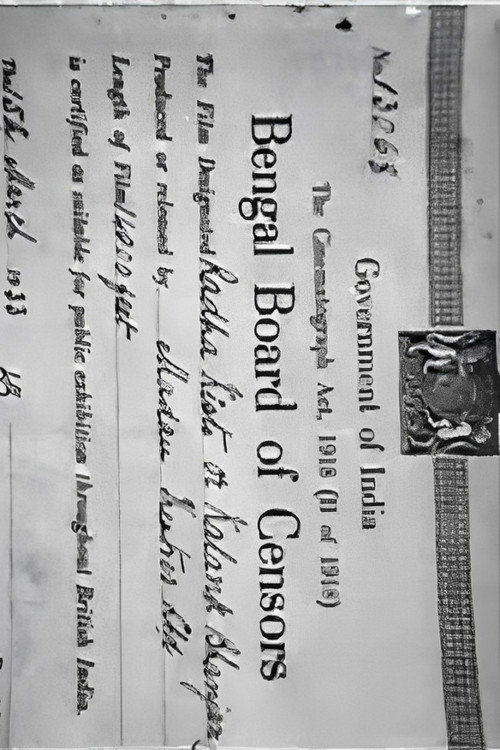 Radha Krishna (1933)
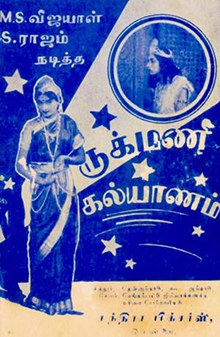 Rukmini Kalyanam (1936)
 Kubera Kuchela (1943)
 Dhaasippen (1943)
- More like this film, on a shelf you can walk up to.It's the lit case on the top shelf.