Neecha Nagar (1946)

- Original title
- नीचा नगर
- Directed by
- Chetan Anand
- Genre
- drama film
- Country
- British Raj
- Runtime
- 2h 02m
- Rating
- 6.3 of 10 from 10 voters
- Elsewhere
- IMDb

The catalogue in 3D
The film shelves have a room of their own that you can walk around in. The cat behind the counter is the AI Catbot, and they pick real films from the same catalogue when you tell them what you feel like watching. Nothing is for sale, here or in there. Go in from here and this film is already out on the counter, with more like it waiting on the shelf next to it.
How it feels
A poor community in a city struggles against a wealthy landlord. The film follows the lives of several residents living in slums as they face injustice and try to survive.
grittysocially consciousbleakslow-burnearnesthumanistrestrained
What happens
Neecha Nagar (lit. 'Lowly City') is a 1946 Indian Hindi-language film, directed by Chetan Anand, written by Khwaja Ahmad Abbas and Hayatullah Ansari, and produced by Rashid Anwar and A. Halim. It was a pioneering effort in social realism in Indian cinema and led to many such parallel cinema films by other directors, many of them also written by Khwaja Ahmad Abbas. It starred Chetan Anand's wife Uma Anand, with Rafiq Anwar, Kamini Kaushal, Murad, Rafi Peer, Hamid Butt, and Zohra Sehgal. Neecha Nagar was a Hindi film adaptation in an Indian setting of Russian writer Maxim Gorky's 1902 play The Lower Depths. Neecha Nagar became the first Indian film to gain recognition at the Cannes Film Festival, after it shared the Grand Prix du Festival International du Film (Best Film) award at the first Cannes Film Festival in 1946 with eleven of the eighteen entered feature films. It is the only Indian film to be ever awarded a Palme d'Or. Ironically, the film was never released in India. However the film was telecasted on Doordarshan, (India's national broadcaster) in 1980s. (from Wikipedia, CC BY-SA)
More like this
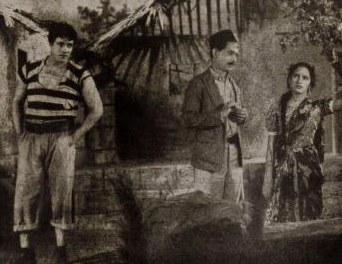 Bhookh (1946)
 Chehra (1946)
 Laat Saheb (1946)
 Arthanaari (1946)
 Hum Ek Hain (1946)
 Dhadkan (1946)
 Pehchan (1946)
 Door Chalen (1946)
- More like this film, on a shelf you can walk up to.It's the lit case on the top shelf.