Miss Malini (1947)

- Directed by
- Kothamangalam Subbu
- Genre
- comedy drama
- Country
- British Raj
- Rated
- U
- Elsewhere
- IMDb
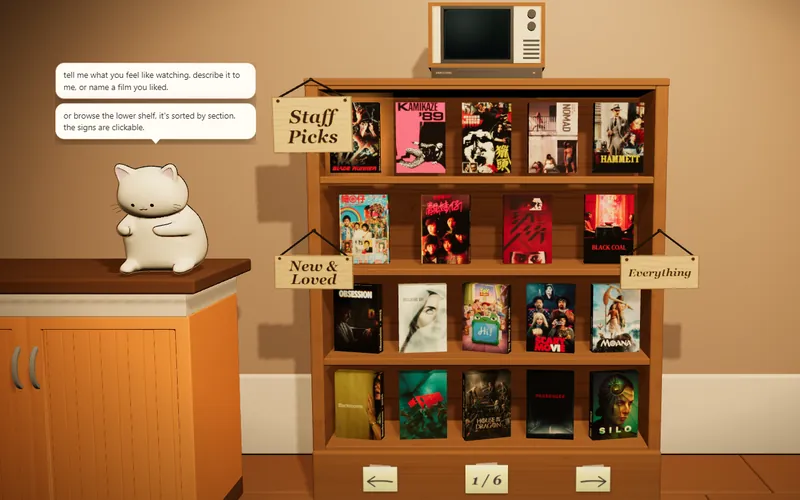
The catalogue in 3D
The film shelves have a room of their own that you can walk around in. The cat behind the counter is the AI Catbot, and they pick real films from the same catalogue when you tell them what you feel like watching. Nothing is for sale, here or in there. Go in from here and this film is already out on the counter, with more like it waiting on the shelf next to it.
How it feels
An impoverished woman joins a theatre company and becomes a star. But her success is threatened when she befriends a charming fraud.
satiricallightheartedwryenergeticold-fashionedunderdog-storyclever
What happens
Miss Malini is a 1947 Indian Tamil-language satirical comedy drama film written and directed by Kothamangalam Subbu and produced by K. Ramnoth, from a story by R. K. Narayan. Subbu also starred in the film alongside Pushpavalli, Sundari Bai and Subbiah Pillai. Javar Seetharaman and Gemini Ganesan made their acting debuts in the film appearing in minor roles. The film focuses on Malini (Pushpavalli), an impoverished woman who joins her actress friend Sundari's (Sundari Bai) theatre company and becomes a success. Matters worsen when she befriends Sampath (Subbu), a charlatan. Miss Malini ridiculed aspects of life in Madras (now Chennai) during the World War II period, and was the only story written by Narayan for the screen that came to fruition. It was released on 26 September 1947, and was accompanied in theatres by Cinema Kadhambam, the first animated film produced in South Indian cinema. Miss Malini was praised by intellectuals; Subbu's performance as Sampath was widely appreciated. The songs composed by S. Rajeswara Rao and Parur S. Anantharaman became popular, and the film gained cult status in Tamil cinema. Miss Malini marked Narayan's earliest use of story elements that would recur in some of his later novels. It was later rewritten by him as the 1949 novel Mr. Sampath – The Printer of Malgudi, which in turn was adapted into the Hindi film Mr. Sampat (1952) directed by S. S. Vasan, and a 1972 Tamil film directed by Cho Ramaswamy. Although no print of Miss Malini is known to survive, thereby making it a lost film, surviving artefacts include its songs, along with a few stills and newspaper advertisements. (from Wikipedia, CC BY-SA)
More like this
 Aaj Aur Kal (1947)
 Vichitra Vanitha (1947)
 Manmani (1947)
 Vidyapathi (1946)
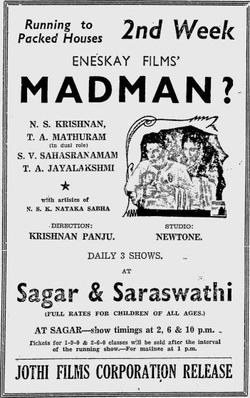 Paithiyakkaran (1947)
 Nam Iruvar (1947)
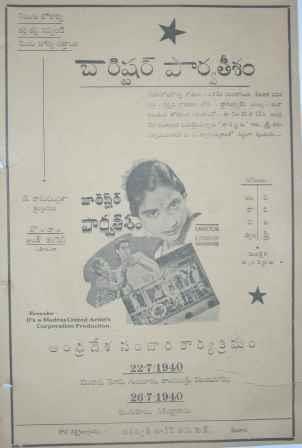 Barrister Parvateesam (1940)
 Manjhdhar (1947)
- More like this film, on a shelf you can walk up to.It's the lit case on the top shelf.