The Flowers of St. Francis (1950)

- Original title
- Francesco, giullare di Dio
- Directed by
- Roberto Rossellini
- Genre
- drama film
- Country
- Italy
- Runtime
- 1h 25m
- Rated
- NR
- Rating
- 7.1 of 10 from 101 voters
- Elsewhere
- IMDb
The catalogue in 3D
The film shelves have a room of their own that you can walk around in. The cat behind the counter is the AI Catbot, and they pick real films from the same catalogue when you tell them what you feel like watching. Nothing is for sale, here or in there. Go in from here and this film is already out on the counter, with more like it waiting on the shelf next to it.
How it feels
The film tells short stories from the life of Saint Francis and his early followers. Each scene is a small parable with a moral lesson. It shows the simple faith and daily actions of the Franciscan monks.
reverentinstructionalgentleepisodicserenemeditativegroundedparable-likehumble
What happens
The Flowers of St. Francis (in Italian, Francesco, giullare di Dio, or "Francis, God's Jester") is a 1950 film directed by Roberto Rossellini and co-written by Federico Fellini. The film is based on two books, the 14th-century novel Fioretti di San Francesco (Little Flowers of St. Francis) and La Vita di Frate Ginepro (The Life of Brother Juniper), both of which relate the life and work of St. Francis and the early Franciscans. I Fioretti is composed of 78 small chapters. The novel as a whole is less biographical and instead focuses on relating tales of the life of St. Francis and his followers. The movie follows the same premise, though rather than relating all 78 chapters, it focuses instead on nine of them. Each chapter is composed in the style of a parable and, like parables, contains a moral theme. Every new scene transitions with a chapter marker, a device that directly relates the film to the novel. On October 6, 1952, when the movie debuted in America, where the novel was much less known, the chapter markers were removed. Included in the acting cast is Gianfranco Bellini as the narrator, who has voice-dubbed several American films for the Italian cinema. Monks from the Nocere Inferiore Monastery played the roles of St. Francis and the friars. Playing the role of St. Francis is a Franciscan brother who is not credited, Brother Nazario Gerardi. The only professional actor in the film is the prominent Aldo Fabrizi, who had worked with Rossellini before, notably in the neorealistic film Rome, Open City. The film garnered international acclaim for Fabrizi. He began his film career scene in 1942 and is noted for both writing and directing his own vehicles. In this film, Fabrizi plays the role of Nicolaio, the tyrant of Viterbo. Rossellini had a strong interest in Christian values in the contemporary world. Though he was not a practicing Catholic, Rossellini loved the Church's ethical teaching and was enchanted by religious sentiment—things that were neglected in the materialistic world. This interest helped to inspire the making of the film. He also employed two priests to work on it with him, Félix A. Morlion O.P., and Antonio Lisandri O.F.M. Though the priests contributed little to the script, their presence within the movie gave a feel of respectability with regard to theology. Morlion vigorously defended Catholic foundations within Italian neorealism and felt that Rossellini's work, and eventually scriptwriter Fellini's, best captured this foundation. (from Wikipedia, CC BY-SA)
More like this
 Il voto (1950)
 Margaret of Cortona (1950)
 Vent'anni (1950)
 Legend of Love (1950)
 Born of Unknown Father (1950)
 Tomorrow Is Too Late (1950)
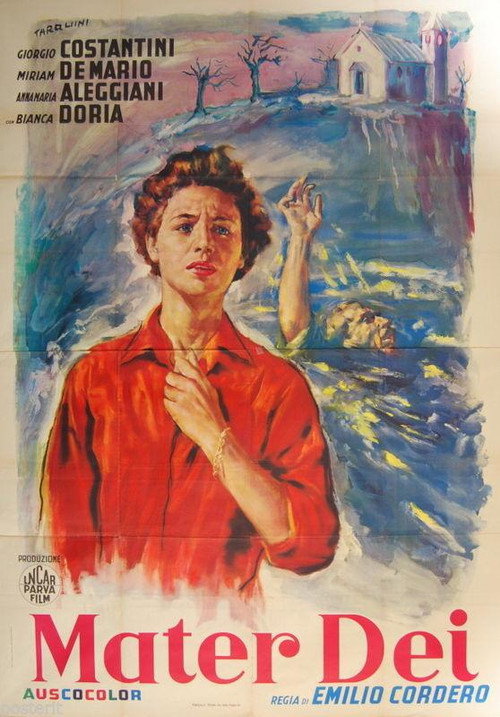 Mater dei (1950)
 Vento d'Africa (1950)
- More like this film, on a shelf you can walk up to.It's the lit case on the top shelf.