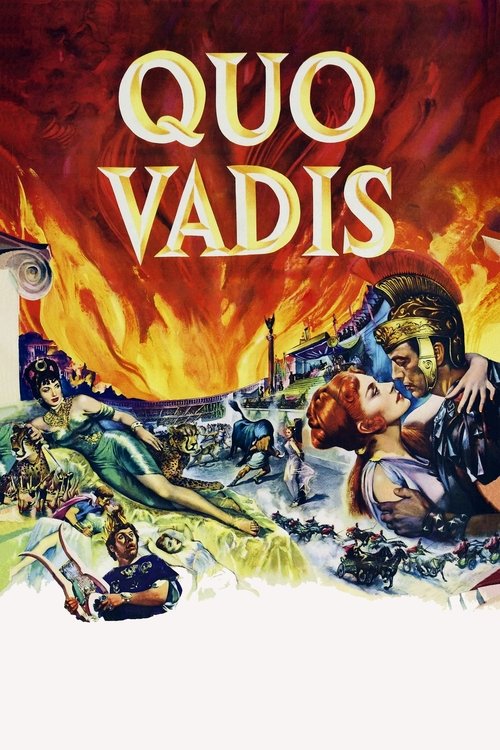
Quo Vadis (1951)
- Directed by
- Mervyn LeRoy
- Genre
- drama film, sword-and-sandal film
- Country
- United States
- Runtime
- 2h 51m
- Rated
- NR
- Rating
- 7.1 of 10 from 455 voters
- Elsewhere
- IMDb

The catalogue in 3D
The film shelves have a room of their own that you can walk around in. The cat behind the counter is the AI Catbot, and they pick real films from the same catalogue when you tell them what you feel like watching. Nothing is for sale, here or in there. Go in from here and this film is already out on the counter, with more like it waiting on the shelf next to it.
How it feels
A Roman general falls in love with a Christian woman during the reign of Emperor Nero. He navigates his loyalty to Rome and his growing faith amid the emperor's persecution of Christians.
epicdramaticgrandsolemninspiringstatelyintensehistorical
What happens
Quo Vadis (Latin for "Where are you going?") is a 1951 American religious epic historical film set in ancient Rome during the final years of Emperor Nero's reign, based on the 1896 novel of the same title by Polish Nobel Laureate author Henryk Sienkiewicz. Produced by Metro-Goldwyn-Mayer and filmed in Technicolor, it was directed by Mervyn LeRoy from a screenplay by S. N. Behrman, Sonya Levien, and John Lee Mahin. It is the fourth screen adaptation of Sienkiewicz's novel. The film stars Robert Taylor, Deborah Kerr, Leo Genn, and Peter Ustinov, and features Patricia Laffan, Finlay Currie, Abraham Sofaer, Marina Berti, Buddy Baer, and Felix Aylmer. Future Italian stars Sophia Loren and Bud Spencer appeared as uncredited extras. The score is by Miklós Rózsa and the cinematography by Robert Surtees and William V. Skall. The film was released by Metro-Goldwyn-Mayer on November 2, 1951. The story, set between 64 and 68 AD, combines both historical and fictional events and characters, and compresses the key events of that period into the space of only a few weeks. Its main theme is the Roman Empire’s conflict with Christianity and persecution of Christians in the final years of the Julio-Claudian line. Unlike his illustrious and powerful predecessor, Emperor Claudius, Nero proved corrupt and destructive, and his actions eventually threatened to destroy Rome's previously peaceful social order. The title refers to an incident in the apocryphal Acts of Peter. The film was nominated for eight Academy Awards, including Best Picture, and it was such a huge box office success that it was credited with single-handedly rescuing MGM from the brink of bankruptcy. Peter Ustinov won the Golden Globe Award for Best Supporting Actor – Motion Picture, and Robert Surtees and William V. Skall won the award for Best Cinematography. (from Wikipedia, CC BY-SA)
More like this
 Sign of the Pagan (1954)
 The Fall of the Roman Empire (1964)
 Fabiola (1949)
 Thunder of Battle (1964)
 Gladiator (2000)
 The Last Days of Pompeii (1950)
 The Robe (1953)
 Jesus of Nazareth (1977)
- More like this film, on a shelf you can walk up to.It's the lit case on the top shelf.