The Power Principle
- Directed by
- Scott Noble
- Genre
- documentary film
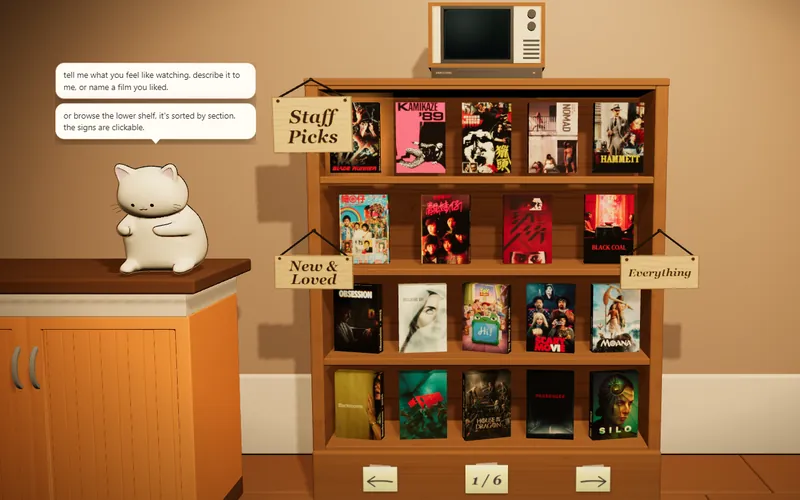
The catalogue in 3D
The film shelves have a room of their own that you can walk around in. The cat behind the counter is the AI Catbot, and they pick real films from the same catalogue when you tell them what you feel like watching. Nothing is for sale, here or in there. Go in from here and this film is already out on the counter, with more like it waiting on the shelf next to it.
How it feels
This documentary argues that U.S. government, military and media interests collaborated to create a propaganda system that frightens the public into supporting military spending and foreign interventions. It claims this system was partly modeled on Nazi propaganda and was used to justify invasions, support for violent regimes, and overthrow of elected governments during the Cold War.
informationalcriticalsoberangryanalyticalaccusatorydensehistoricalunsettling
What happens
The Power Principle is a non-profit documentary movie directed by Scott Noble and released online for free. The film makers explore how, in their view, the United States establishment promotes a culture of fear in order to secure increased military expenses, year after year. The film claims the U.S. government and the military-industrial complex, together with the U.S. media, developed a powerful propaganda machinery (inspired in good part from Nazi propaganda) in order to scare and convince the public that U.S. invasions like those in Dominican Republic (1965), Grenada (1983), U.S. support for brutal mass killings, terror campaigns like those in Guatemala (1954), Indonesia (1965), El Salvador (1979), US-designed assassination plots like those in Nicaragua (1981) and in huge parts of Latin America (Operation Condor) and support for overthrowing democratically elected governments like those in Brazil (1964) and Chile (1973) were needed in order to prevent the spread of communism, using mainly the domino theory. The movie also points at the help provided by the Western countries to fascist regimes in order to counter movements supporting workers rights (socialism, communism, anarchy). The fascism is presented as an instrument in the hands of the plutocracy for oppressing and enslaving the working class. The meaning of the movie's title, "The power principle" is revealed as the Mafia principle, which is "not allowing disobedience" - in this case not allowing the countries in the developing world to have governments that try to improve the life of the many. The movie traces the roots of the U.S. establishment (both Republican and Democrat parties) mindset into the doctrine of Edward Bernays, pioneer in the field of public relations and propaganda, who believed the democracy is hard to handle and people are just too stupid to govern themselves in democracy, so there is a need of an elite, public guardians who manage the society and there is a need of public relation practitioners who would be professionals in working for the government for managing, manipulating the public and engineering consent. The film is split into three parts: "Empire", "Propaganda" and "Apocalypse". (from Wikipedia, CC BY-SA)
More like this
 War Made Easy: How Presidents & Pundits Keep Spinning Us to Death (2007)
 The Big Lie (1951)
 Hijacking Catastrophe (2004)
 3rd Riech: Evil Deception (2016)
 Zeitgeist: Addendum (2008)
 Here Is Germany (1945)
 The Perfect Weapon (2020)
 Zeitgeist: The Movie (2007)
- More like this film, on a shelf you can walk up to.It's the lit case on the top shelf.