The Battle of Gettysburg (1955)

- Directed by
- Herman Hoffman
- Genre
- documentary film
- Country
- United States
- Runtime
- 30 min
- Rating
- 6.1 of 10 from 8 voters
- Elsewhere
- IMDb
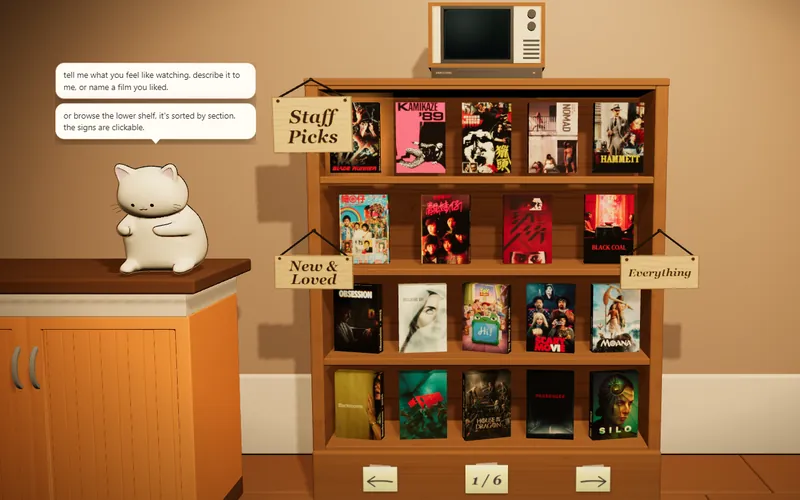
The catalogue in 3D
The film shelves have a room of their own that you can walk around in. The cat behind the counter is the AI Catbot, and they pick real films from the same catalogue when you tell them what you feel like watching. Nothing is for sale, here or in there. Go in from here and this film is already out on the counter, with more like it waiting on the shelf next to it.
How it feels
This documentary covers the Battle of Gettysburg during the American Civil War. It uses narration by Leslie Nielsen and Civil War era songs. No actors appear instead the film photographs statues and bas-reliefs at the battlefield to suggest a reenactment.
informativereverentstaticeducationalseriousnostalgicslow-pacedvisually creative
What happens
The Battle of Gettysburg is a 1955 American documentary film about the Battle of Gettysburg during the American Civil War. The film was nominated for two Academy Awards. The documentary was filmed in Cinemascope and Eastmancolor entirely on location at the Gettysburg National Military Park in south-central Pennsylvania. Leslie Nielsen provides narration, while songs from the Civil War era are played in the background with the sound effects of battle. At the end of the film, Nielsen reads the Gettysburg Address. No actors appear onscreen. Memorial statues and bas-reliefs already present on the battlefield were photographed from various angles and distances, then the footage was juxtaposed to suggest that the static images were actual characters taking part in a dramatic re-enactment of the battle. In some scenes, the turbulence created by an off-screen helicopter is used to press down tall grasses, suggesting the passage of invisible soldiers. In 1956, the film was nominated for Oscars for Best Documentary, Short Subject (Dore Schary) and Best Short Subject, Two-reel (also for Dore Schary). (from Wikipedia, CC BY-SA)
More like this
 The Gettysburg Story
 Gettysburg (2011)
 Gettysburg (1863) (2006)
 The True Story of the Civil War (1956)
 The Gettysburg Address (2017)
 Cassino to Korea (1950)
 The Blue and the Gray (1935)
 The Civil War (1990)
- More like this film, on a shelf you can walk up to.It's the lit case on the top shelf.