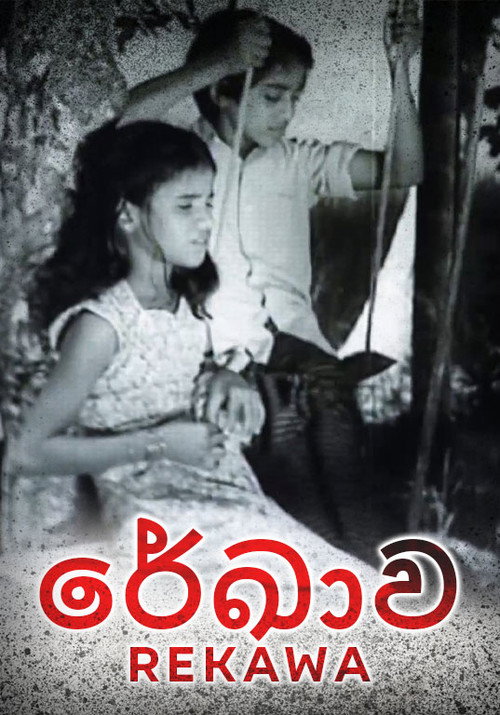
Rekava (1956)
- Original title
- රේඛාව
- Directed by
- Lester James Peries
- Genre
- drama film
- Country
- Sri Lanka
- Runtime
- 1h 29m
- Rating
- 7.2 of 10 from 8 voters
- Elsewhere
- IMDb
The catalogue in 3D
The film shelves have a room of their own that you can walk around in. The cat behind the counter is the AI Catbot, and they pick real films from the same catalogue when you tell them what you feel like watching. Nothing is for sale, here or in there. Go in from here and this film is already out on the counter, with more like it waiting on the shelf next to it.
How it feels
A young boy in a Sri Lankan village sees visions of a future he cannot control. The film follows his family and neighbors as they navigate local myths and everyday life.
groundedatmosphericcontemplativenaturalisticculturally specificunderstatedearthyunadorned
What happens
Rekava (Sinhala for "Line of Destiny") is a 1956 film based on village life and mythical beliefs in Sri Lanka (then Ceylon). It was the first Sinhala film to be shot entirely in Ceylon, using outdoor locations across the country. The film is also regarded as the first Sri Lankan production free from Indian influence. At the time, many Sinhala films were remakes of South Indian movies, often failing to reflect the local context and featuring stilted, unnatural dialogue. Rekava was the debut film of Sri Lankan director Lester James Peries's and also marked the first work of cinematographer Willie Blake. The film received international acclaim and was selected for the main competition at the 1957 Cannes Film Festival. It is still the only Sri Lankan film nominated for the Palme d'Or. Despite its critical acclaim, Rekava was not a commercial success in Sri Lanka, largely because it broke away from mainstream film conventions such as boy-meets-girl romance, fight sequences, comedic interludes, and Hindi-style musical numbers. Over time, however, it has come to be recognized as one of the most important and best-known Sinhala films, widely regarded as marking the birth of a uniquely Sri Lankan cinema. On 28 December 2006, the film was screened at the Regal Cinema in Ceylon Theatre at 5 p.m. to commemorate the 50th anniversary of its original premiere, which had taken place in the same theater on 28 December 1956. (from Wikipedia, CC BY-SA)
More like this
 Udugan Yamaya (2006)
 Ammawarune (2006)
 Sikuru Tharuwa (1963)
 Adarawanthayo (1968)
 Surangani (1955)
 Sewwandi (2006)
 How I Wonder What You Are (2010)
 Kurulu Bedda (1961)
- More like this film, on a shelf you can walk up to.It's the lit case on the top shelf.