The Horse with the Flying Tail (1960)
- Directed by
- Larry Lansburgh
- Genre
- documentary film
- Country
- United States
- Runtime
- 48 min
- Rating
- 7.3 of 10 from 14 voters
- Elsewhere
- IMDb

The catalogue in 3D
The film shelves have a room of their own that you can walk around in. The cat behind the counter is the AI Catbot, and they pick real films from the same catalogue when you tell them what you feel like watching. Nothing is for sale, here or in there. Go in from here and this film is already out on the counter, with more like it waiting on the shelf next to it.
How it feels
This documentary tells the true story of a palomino horse named Nautical who went from an unknown stock horse to winning a team gold medal in jumping at the 1959 Pan American Games. The film follows his training and career as an open jumper at national horse shows in the United States.
upliftingwholesomeinspirationalfamily-friendlypositivelightheartedinformativegentle
What happens
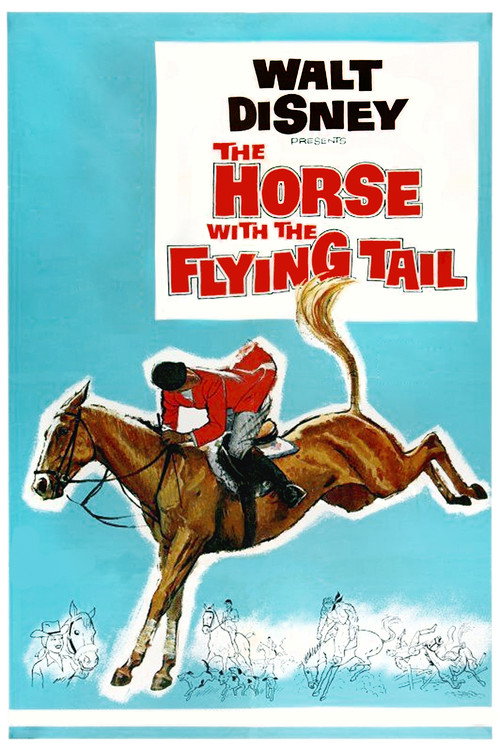
The Horse with the Flying Tail is a 1960 American documentary film by Walt Disney Productions that won the Best Documentary award at the 33rd Academy Awards. The film is about the palomino horse, Nautical, who won the team gold medal at the 1959 Pan American Games. The film was released theatrically on a double bill with Swiss Family Robinson, and was later broadcast on Walt Disney's Wonderful World of Color in 1964. The film portrays this horse as having been an undistinguished stock horse, but in fact, he was sired by an American Quarter Horse named Muchacho de Oro out of an Army Remount mare of predominantly Thoroughbred breeding. This horse's registered name, Pelo de Oro, was given to him at birth. It translates to "Coat of Gold". He became an open jumper and was shown in the national horse show circuit in the United States. Open jumpers compete for scores based on faults (if a jump is refused or a rail knocked down) that are combined with the time elapsed to complete the course. Prior to his Olympic fame, he had a reputation as a temperamental jumper who was inclined to stop unexpectedly at water-and-ditch jumps. Such refusals would disqualify a jumper from an event. His nickname among competitors was "Sneaky Pete" for those reasons and as his distinctive nature became well known, spectators began to identify him by the nickname as well. He was an excellent jumper (when willing) and he became especially popular because consistently when he cleared a fence, Sneaky Pete would raise his tail in the characteristic fashion shown in the photograph displayed from the film. That uplifted tail, raised so high, was repeated by the horse for each faultless jump and spectators at horse shows relied upon this signal from the horse to record his scores, without waiting for the results from the judges, hence the title of the film about his career. When he was obtained by Hugh Wiley, Wiley enlisted the help of the United States Equestrian Team coach, Bertalan de Nemethy. Together the two men trained the horse in New Jersey at the Coates estate (the first home of the national equestrian team) on van Beuren Road in Morristown and later, at the facility developed for the team in Gladstone and he became an Olympic-level open jumper. "Sneaky Pete" then became known as "Nautical" and was ridden regularly by members of the United States Equestrian Team in international competitions. (from Wikipedia, CC BY-SA)
More like this
 Golden Horses (1946)
 Secretariat (2010)
 Seabiscuit (2003)
 Windjammer (1958)
 A Step Away (1980)
 The Seahorse (1935)
 Cinderella Horse (1948)
 Morning Light (2008)
- More like this film, on a shelf you can walk up to.It's the lit case on the top shelf.