The Colossus of Rhodes (1961)

- Original title
- Il colosso di Rodi
- Directed by
- Sergio Leone
- Genre
- drama film, adventure film, historical film
- Country
- France, Italy, Spain
- Runtime
- 2h 05m
- Rated
- 12
- Rating
- 5.9 of 10 from 214 voters
- Elsewhere
- IMDb

The catalogue in 3D
The film shelves have a room of their own that you can walk around in. The cat behind the counter is the AI Catbot, and they pick real films from the same catalogue when you tell them what you feel like watching. Nothing is for sale, here or in there. Go in from here and this film is already out on the counter, with more like it waiting on the shelf next to it.
How it feels
A war hero arrives on the island of Rhodes during the Hellenistic period. He gets caught up in two separate plots to overthrow the king, one led by local patriots and another by Phoenician agents.
historicalepicadventurousdramaticswashbucklinglightheartedformulaic
What happens
The Colossus of Rhodes (Italian: Il Colosso di Rodi) is a 1961 Italian sword and sandal film co-written and directed by Sergio Leone. Starring Rory Calhoun, it is a fictional account of the island of Rhodes during its classical period in the late third century BC before coming under Roman control, using the Colossus of Rhodes as a backdrop for the story of a war hero who becomes involved in two different plots to overthrow a tyrannical king: one by Rhodian patriots and the other by Phoenician agents. The film was Leone's first work as a credited director, in a genre where he already had worked before (as the replacement director for The Last Days of Pompeii and as a secondary director for both Ben-Hur and Quo Vadis). It is perhaps the least known of the seven films he officially directed, and is the only one without an Ennio Morricone score. The film is set during the time following Alexander the Great’s death (323 BC) but before the rise of the Roman Empire (27 BC), known as the Hellenistic era. Most sword-and-sandal epics of the 1950s and 1960s were set in either classical Greece or even earlier (Hercules, Ulysses, The Giant of Marathon) or the later Roman period (Ben Hur, The Magnificent Gladiator, Quo Vadis). The only other films made during the peplum era to use a Hellenistic setting are Hannibal (1959), Revak the Rebel and Siege of Syracuse (both 1960). (from Wikipedia, CC BY-SA)
More like this
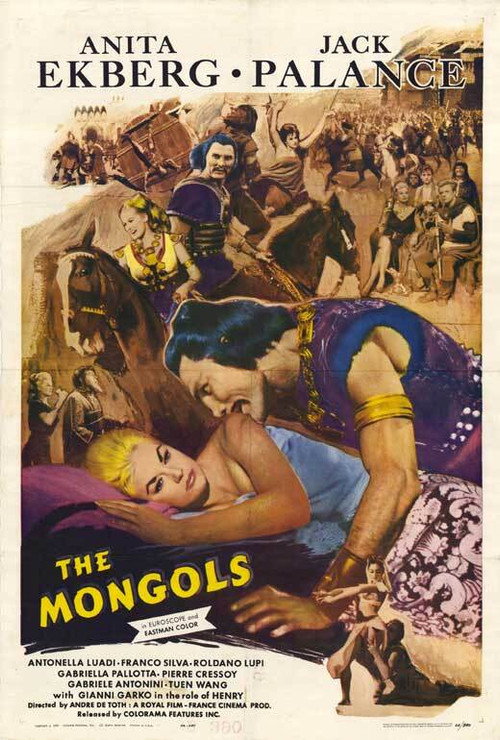 The Mongols (1961)
 The Count of Monte Cristo (1961)
 Rome 1585 (1961)
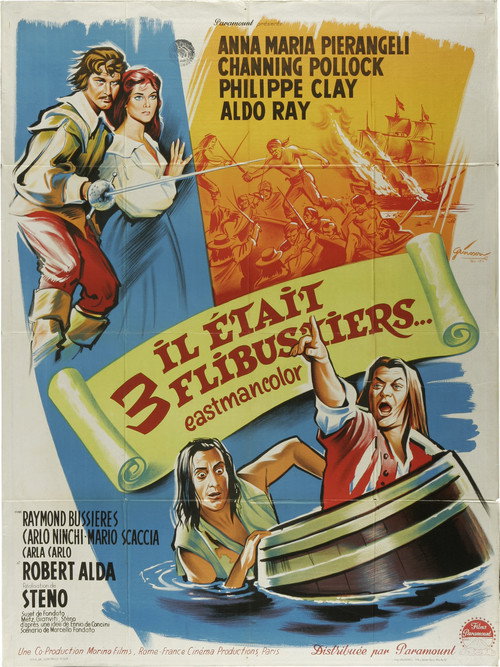 Musketeers of the Sea (1961)
 El Cid (1961)
 White Slave Ship (1961)
 Revenge of the Conquered (1961)
 Sword in the Shadows (1961)
- More like this film, on a shelf you can walk up to.It's the lit case on the top shelf.