How the West Was Won (1962)

- Directed by
- George Marshall, Henry Hathaway, John Ford
- Genre
- drama film, Western film
- Country
- United States
- Runtime
- 2h 42m
- Rated
- G
- Rating
- 7.0 of 10 from 501 voters
- Elsewhere
- IMDb
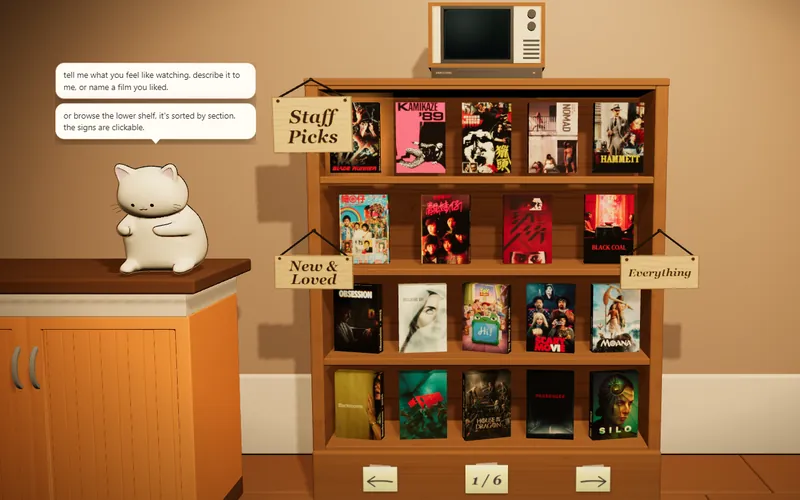
The catalogue in 3D
The film shelves have a room of their own that you can walk around in. The cat behind the counter is the AI Catbot, and they pick real films from the same catalogue when you tell them what you feel like watching. Nothing is for sale, here or in there. Go in from here and this film is already out on the counter, with more like it waiting on the shelf next to it.
How it feels
A family moves westward across America over several generations. The film follows their struggles and adventures as they settle the frontier.
epicsweepingnostalgicgrandbriskearnestsprawlingsentimental
What happens
How the West Was Won is a 1962 American epic Western film directed by Henry Hathaway (who directed three out of the five chapters: "The Rivers," "The Plains" and "The Outlaws"), John Ford ("The Civil War") and George Marshall ("The Railroad"), produced by Bernard Smith, written by James R. Webb, and narrated by Spencer Tracy. The film centers on a family and their descendants over the span of decades as they explore and settle the American frontier of the United States. Originally filmed in true three-lens Cinerama with the accompanying three-panel panorama projected onto an enormous curved screen, the film features an ensemble cast formed by many cinema icons and newcomers, including (in alphabetical order) Carroll Baker, Lee J. Cobb, Henry Fonda, Carolyn Jones, Karl Malden, Gregory Peck, George Peppard, Robert Preston, Debbie Reynolds, James Stewart, Eli Wallach, John Wayne and Richard Widmark. The supporting cast features Brigid Bazlen, Walter Brennan, David Brian, Andy Devine, Raymond Massey, Agnes Moorehead, Harry Morgan, Thelma Ritter, Mickey Shaughnessy and Russ Tamblyn. How the West Was Won is widely considered one of Hollywood's greatest epics. The film received widespread critical acclaim and was a box office success, grossing $50 million on a budget of $15 million. At the 36th Academy Awards it earned eight nominations, including Best Picture, and won three, for Best Story and Screenplay Written Directly for the Screen, Best Sound and Best Film Editing. In 1997, it was selected for preservation in the United States National Film Registry by the Library of Congress as being "culturally, historically or aesthetically significant". (from Wikipedia, CC BY-SA)
More like this
 Shoot Out at Big Sag (1962)
 Unaired Pilot: This Rugged Land (1962)
 Giant (1956)
 Stagecoach to Dancers' Rock (1962)
 Six Black Horses (1962)
 Ride the High Country (1962)
 The Searchers (1956)
 The Man Who Shot Liberty Valance (1962)
- More like this film, on a shelf you can walk up to.It's the lit case on the top shelf.