Love at Twenty (1962)
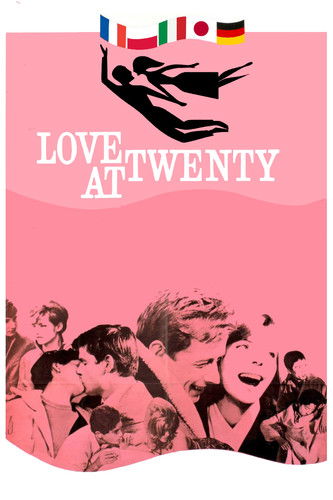
- Original title
- L'Amour à vingt ans
- Directed by
- Renzo Rossellini, Marcel Ophuls, Andrzej Wajda, François Truffaut
- Genre
- comedy film
- Country
- Germany, France, Italy, Poland
- Runtime
- 2h
- Rated
- G
- Rating
- 6.7 of 10 from 53 voters
- Elsewhere
- IMDb
How it feels
Five directors from different countries each contribute a short film about love and heartbreak at age twenty. The segments follow young people navigating infatuation, rejection, and obsession in France, Italy, Japan, Poland, and Germany.
bittersweetromanticwistfulepisodicyouthfulmelancholicawkwardobservational
What happens
Love at Twenty (French: L'Amour à vingt ans, Japanese: 二十歳の恋, romanized: Hatachi no koi, Italian: L'amore a vent'anni, German: Liebe mit zwanzig, Polish: Miłość dwudziestolatków) is a 1962 French-produced omnibus project of Pierre Roustang, consisting of five segments, each with a different director from a different country. It was entered into the 12th Berlin International Film Festival. The first segment, titled "Antoine and Colette", is by François Truffaut and returns actor Jean-Pierre Léaud to the role of Antoine Doinel, a role he played three years earlier in The 400 Blows and would return to again in 1968 (Stolen Kisses), 1970 (Bed and Board) and 1979 (Love on the Run). It concerns the frustrations of love for the now 17-year-old Doinel and the unresponsive girl he adores. The second, titled "Rome", is the directorial debut of 21-year-old Renzo Rossellini, son of Roberto Rossellini and later a noted producer. It tells the story of a tough mistress who loses her lover to an older, wealthier and more appreciative woman. The third, "Tokyo" by Japanese film director Shintarō Ishihara, has been described as a "weird, grotesque" and "clumsy" tale of obsessive and morbid love. The fourth, "Munich", is by Marcel Ophüls and was described as a "charming, but somewhat sentimental" story of an unwed mother who contrives to trap her baby's father. The fifth and final segment, "Warsaw" by Andrzej Wajda, depicts a brief intergenerational liaison based upon multiple misunderstandings. The episodes are tied together with still photos by Henri Cartier-Bresson and a verse of the film’s theme by Georges Delerue sung by Xavier Depraz in the language of the preceding vignette. Truffaut's and Wajda's segments (the first and the last, respectively) are considered the highlights. (from Wikipedia, CC BY-SA)
More like this
- Of Wayward Love (1962)
- Tales of Paris (1962)
- Boccaccio '70 (1962)
- Love, Rosie (2014)
- Paris, My Love (1962)
- Three Fables of Love (1962)
- Il sorpasso (1962)
- Rencontres (1962)
Browse movies and series
press Enter to search by title, your filters still apply · for something by mood, tap Discover
Lists: Korean thrillers worth the evening · Anime films beyond Studio Ghibli · Slow films for a rainy night · Horror that unsettles instead of startling · Series you can finish in a weekend · Nordic crime worth the subtitles · Good films that end in under 90 minutes · Documentaries that play like thrillers
Loading movies…