Nartanasala (1962)

- Original title
- నర్తనశాల
- Directed by
- Kamalakara Kameshwara Rao
- Genre
- musical film
- Country
- India
- Runtime
- 2h 55m
- Rated
- U
- Rating
- 7.0 of 10 from 4 voters
- Elsewhere
- IMDb
The catalogue in 3D
The film shelves have a room of their own that you can walk around in. The cat behind the counter is the AI Catbot, and they pick real films from the same catalogue when you tell them what you feel like watching. Nothing is for sale, here or in there. Go in from here and this film is already out on the counter, with more like it waiting on the shelf next to it.
How it feels
This is a Telugu mythological film based on the Mahabharata. The Pandava brothers live in disguise during their final year of exile in King Virata's kingdom. They face threats from the Kauravas and conflict with the king's brother-in-law Kichaka.
mythicemotionaldramaticslow-burnmusicalepicseriousornate
What happens
Nartanasala (transl. The dance pavilion) is a 1963 Indian Telugu-language Hindu mythological film directed by Kamalakara Kameswara Rao and written by Samudrala Sr. It stars N. T. Rama Rao, Savitri, S. V. Ranga Rao, and Relangi while Mukkamala, Mikkilineni and Dandamudi Rajagopal play supporting roles among others. Susarla Dakshinamurthi composed the film's soundtrack and background score. M. A. Rahman and S. P. S. Veerappa served as the cinematographer and editor respectively. T. V. S. Sarma was the film's art director. The film was produced by actress C. Lakshmi Rajyam and her husband C. Sridhar Rao under the Rajyam Pictures banner. Based on the Virata Parva of the Indian epic Mahabharata, Nartanasala focused on the trials of the Pandavas in the last year of their exile. The Pandavas assumed different identities and lived incognito in Virata's Matsya Kingdom. The Kauravas wished to reveal the Pandavas' real identities so that they would repeat another exile of 13 years in a cyclic fashion. The issues faced by the Pandavas and their wife Draupadi at Matsya due to various factors, notably Virata's brother-in-law Kichaka form the rest of the story. The majority of Nartanasala's portions were filmed in the sets erected at Vauhini and Bharani studios in Madras (now Chennai). Produced with a budget of ₹4,00,000, Nartanasala was released on 11 October 1963 in 26 centers. The film was a commercial success, completing a 100-day run in 19 centers and a 200-day run in two centers. It was also dubbed into Bengali and Odia languages. Nartanasala won the National Film Award for Second Best Feature Film and the Filmfare Award for Best Film – Telugu. At the third Afro-Asian Film Festival held at Jakarta in 1964, Nartanasala received two awards: Best Male Actor (Ranga Rao) and Best Art Director (T. V. S. Sarma). For the April 2013 centennial of Indian cinema, News18 included Nartanasala in its list of "The 100 greatest Indian films of all time". (from Wikipedia, CC BY-SA)
More like this
 Pandava Vanavasam (1965)
 నాగార్జున (1962)
 Sri Krishnarjuna Yudham (1963)
 Seetha Rama Kalyanam (1961)
 శ్రీకృష్ణపాండవయుద్ధం (1960)
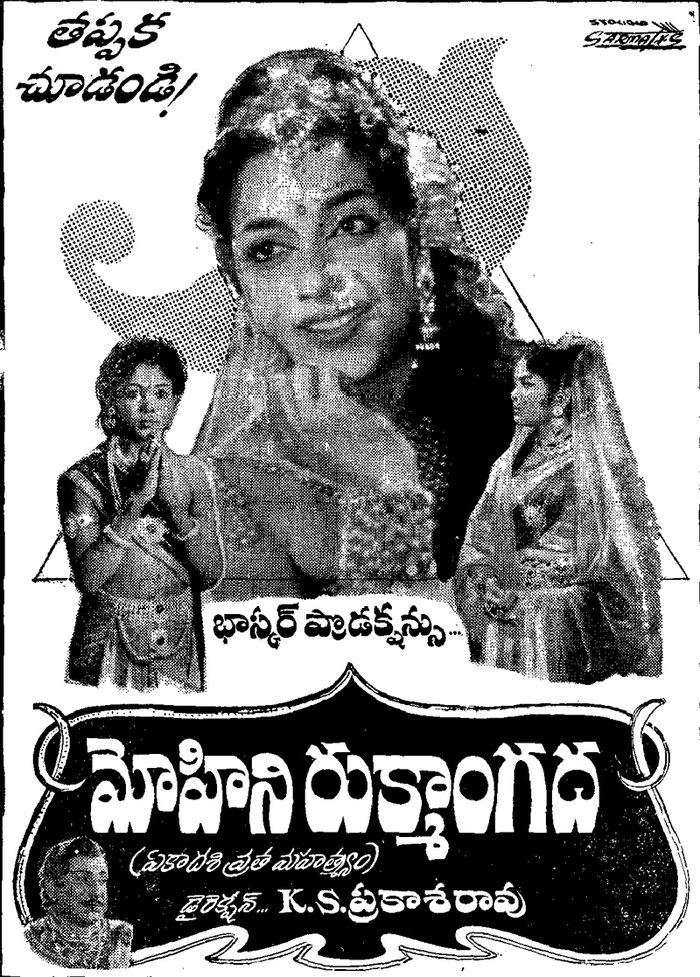 మోహినీ రుక్మాంగద (1962)
 శ్రీకృష్ణ తులాభారం (1955)
 Mahamantri Timmarusu (1962)
- More like this film, on a shelf you can walk up to.It's the lit case on the top shelf.