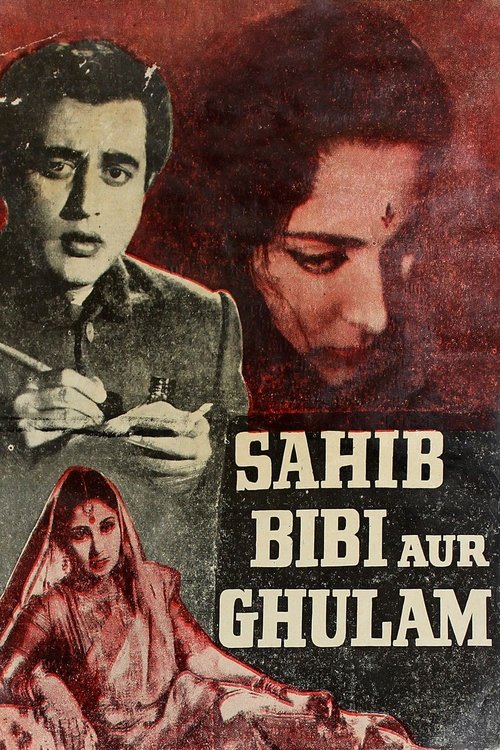
Sahib Bibi Aur Ghulam (1962)
- Original title
- साहिब बीबी और ग़ुलाम
- Directed by
- Abrar Alvi
- Genre
- drama film
- Country
- India
- Runtime
- 2h 32m
- Rating
- 6.9 of 10 from 13 voters
- Elsewhere
- IMDb
The catalogue in 3D
The film shelves have a room of their own that you can walk around in. The cat behind the counter is the AI Catbot, and they pick real films from the same catalogue when you tell them what you feel like watching. Nothing is for sale, here or in there. Go in from here and this film is already out on the counter, with more like it waiting on the shelf next to it.
How it feels
Set in 19th century colonial India, a young man named Bhoothnath meets Chhoti Bahu, the neglected wife of a wealthy landlord. She tries to keep her husband at home by drinking with him, but her plan leads her into addiction and financial ruin.
melancholicslow-burnperiodtragicatmosphericsombercharacter-drivenemotionally intense
What happens
Sahib Bibi Aur Ghulam (transl. The Master, the Wife, and the Slave) is a 1962 Indian Hindi-language drama film directed by Abrar Alvi, produced & co–directed by Guru Dutt, who also co-stars in it alongside Meena Kumari, Rehman, and Waheeda Rehman. It is a remake of the 1956 Bengali film Saheb Bibi Golam, which itself is based on Bimal Mitra's 1953 novel of the same name. It is set in the 19th century during the British Raj and focuses on Bhoothnath (Dutt), who meets Chhoti Bahu (Kumari), the lonely wife of a zamindar (Rehman). The film follows Chhoti Bahu's effort to keep her husband—who likes drinking and watching tawaifs perform—at their home by drinking with him. She becomes addicted to alcohol, leading both of them into bankruptcy. The book's rights were bought after his production venture Chaudhvin Ka Chand (1960) became commercially successful and covered his company's loss following the failure of Kaagaz Ke Phool (1959), his previous directorial project. Mitra and Alvi took a year to write the screenplay, facing difficulties in translating the novel from Bengali to Hindi. Principal photography took place in Andheri and Dhanyakuria with cinematographer V. K. Murthy; the film was edited by Y. G. Chawhan. Hemant Kumar composed the soundtrack and Shakeel Badayuni wrote the lyrics. Sahib Bibi Aur Ghulam was released on 29 July 1962. Although it commercially failed with a gross of ₹8.4 million (US$88,000), it garnered positive responses from critics; most appreciation was given to the cast's performances, particularly that of Kumari, and Murthy's cinematography. Sahib Bibi Aur Ghulam won four Filmfare Awards, including Best Film, Best Director for Alvi, and Best Actress for Kumari. It also received the National Film Award for Best Feature Film in Hindi and the Bengal Film Journalists' Association Award for Sixth Best Indian Film, and Alvi was awarded the Best Director trophy at the latter function. The film was chosen as the Indian submission for the Academy Award for Best Foreign Language Film but it was not nominated. Sahib Bibi Aur Ghulam became a milestone of Bollywood and is considered among the most important films in Dutt's career. In 2012, its screenplay was published as a book titled Sahib Bibi Aur Ghulam: The Original Screenplay, which also contains interviews with the film's cast and crew. On the centenary of Indian cinema in 2013, IBN Live included Sahib Bibi Aur Ghulam in their listing of "100 Greatest Indian Films of All Time". (from Wikipedia, CC BY-SA)
More like this
 Valar Pirai (1962)
 Puthiya Akasam Puthiya Bhoomi (1962)
 Charulata (1964)
 Aatma Bandhuvu (1962)
 Bharya (1962)
 Aadi Perukku (1962)
 ఆశాజీవులు (1962)
 Lakshmi (1962)
- More like this film, on a shelf you can walk up to.It's the lit case on the top shelf.