Naanum Oru Penn (1963)

- Directed by
- A. C. Tirulokchandar
- Genre
- drama film
- Country
- India
- Runtime
- 2h 35m
- Rating
- 6.0 of 10 from 1 voters
- Elsewhere
- IMDb
The catalogue in 3D
The film shelves have a room of their own that you can walk around in. The cat behind the counter is the AI Catbot, and they pick real films from the same catalogue when you tell them what you feel like watching. Nothing is for sale, here or in there. Go in from here and this film is already out on the counter, with more like it waiting on the shelf next to it.
How it feels
A dark-skinned uneducated woman struggles against a society that judges her for her appearance and lack of schooling. She sets out to prove that a person's character matters more than looks or education.
emotionalheartfeltupliftingslow-burnsocially consciouscharacter-drivenearnestdramaticsentimental
What happens
Naanum Oru Penn (transl. I too am a woman) is a 1963 Indian Tamil-language drama film directed by A. C. Tirulokchandar and written by K. P. Kottarakkara. The film stars S. S. Rajendran and R. Vijayakumari, with S. V. Ranga Rao, M. R. Radha, S. V. Subbaiah, C. K. Nagesh, Rajan and C. S. Pushpalatha in supporting roles. It revolves around a dark complexioned and uneducated girl and how she convinces everyone that more than appearance and education, it is the character which is important for a woman. Naanum Oru Penn is an adaptation of Sri Shailesh Dey's Bengali play Bodhu. The film is the second production of Murugan Brothers, a subsidiary of AVM Productions, and the feature film debut of Rajan. The soundtrack and background score were composed by R. Sudarsanam, while the lyrics for the songs were written by Kannadasan, Panchu Arunachalam, Ku. Ma. Balasubramaniam and V. Seetharaman. Naanum Oru Penn was released on 7 June 1963. The film earned positive critical feedback and went on to become a commercial success. It won many awards, including the National Film Award for Best Tamil Feature Film, the Filmfare Award for Best Tamil Film and Cinema Fans Award for Best Film. The film was remade in Hindi as Main Bhi Ladki Hoon (1964) and Telugu as Naadi Aada Janme (1965). Both the versions were directed by Tirulokachander with Ranga Rao reprising his role. (from Wikipedia, CC BY-SA)
More like this
 Naadi Aada Janme (1965)
 Susheela (1963)
 Aapta Mitrulu (1963)
 Nithya Kanyaka (1963)
 Ananda Bashpa (1963)
 Aasai Alaigal (1963)
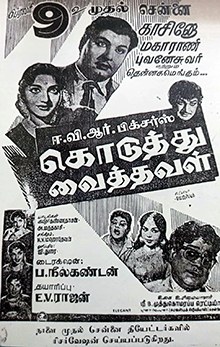 Koduthu Vaithaval (1963)
 Sathyabhama (1963)
- More like this film, on a shelf you can walk up to.It's the lit case on the top shelf.