Aama (1964)

- Original title
- आमा
- Directed by
- Hira Singh Khatri
- Genre
- drama
- Country
- Nepal
- Runtime
- 2h 03m
- Elsewhere
- IMDb
The catalogue in 3D
The film shelves have a room of their own that you can walk around in. The cat behind the counter is the AI Catbot, and they pick real films from the same catalogue when you tell them what you feel like watching. Nothing is for sale, here or in there. Go in from here and this film is already out on the counter, with more like it waiting on the shelf next to it.
How it feels
A young man returns home after serving in his country's army. The film follows his reunion with his mother and adjusts to civilian life.
tenderearnestslowpatrioticlow-budgetsentimentalplot-lightfamily-oriented
What happens
Aama (Nepali: आमा, lit. 'Mother') is a 1964 Nepali drama film directed by Hira Singh Khatri in his directorial debut. The film is written by Durga Shrestha and Chaitya Devi. Aama was produced by King Mahendra of Nepal under the banner of Information Department of Government of Nepal (formally Royal Nepal Film Corporation). The film stars Shiva Shankar Manandhar and Bhuwan Chand, with Basundhara Bhusal, Chitya Devi Singh, Hira Singh Khatri and Hari Prasad Rimal, in supporting roles. It follows a young man who returns home after serving in his country's army. Hira Singh Khatri, was requested by King Mahendra of Nepal to direct Aama. The film's post-production and indoor filming were mainly done in Kolkata, India. It was released on 7 October 1964. After the release, Aama became the first Nepalese film to be produced in Nepal. After the film's release in Nepal, it quickly became popular in the country. After the success of Aama, Khatri directed the films Hijo Aaja Bholi (1967), and Parivartan (1971) for the Nepalese government, both of which were used to convey patriotism to Nepalese citizens. Aama is the first movie ever produced in Nepali Language and regarded as one of the most important films in the history of Nepalese cinema. (from Wikipedia, CC BY-SA)
More like this
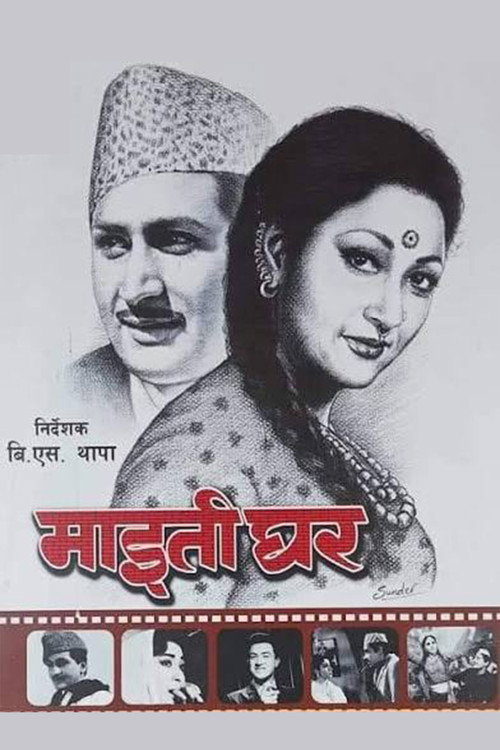 Maitighar (1966)
 Lahure (1989)
 Man ko bandh (1973)
 Mahapurush (2022)
 White Sun (2016)
 Basudev (1984)
 Anna (1964)
 Ritu (2014)
- More like this film, on a shelf you can walk up to.It's the lit case on the top shelf.