Persona (1966)

- Directed by
- Ingmar Bergman
- Genre
- drama film, art film
- Country
- Sweden
- Runtime
- 1h 24m
- Rated
- M
- Rating
- 8.1 of 10 from 2,429 voters
- Elsewhere
- IMDb

The catalogue in 3D
The film shelves have a room of their own that you can walk around in. The cat behind the counter is the AI Catbot, and they pick real films from the same catalogue when you tell them what you feel like watching. Nothing is for sale, here or in there. Go in from here and this film is already out on the counter, with more like it waiting on the shelf next to it.
How it feels
A young nurse cares for a famous actress who has stopped speaking. They move to a cottage where the nurse confides in her patient and begins to lose her own sense of identity.
cerebralslow-burnintimateunsettlingdreamliketensebleakambiguouspsychological
What happens
Persona is a 1966 Swedish avant-garde psychological drama film written, directed, and produced by Ingmar Bergman and starring Bibi Andersson and Liv Ullmann. The story revolves around a young nurse named Alma (Andersson) and her patient, well-known stage actress Elisabet Vogler (Ullmann), who has suddenly stopped speaking. They move to a cottage, where Alma cares for Elisabet, confides in her, and begins having trouble distinguishing herself from her patient. Characterized by elements of psychological drama, Persona has been the subject of much critical analysis, interpretation, and debate. The film's exploration of duality, insanity, and personal identity has been interpreted as reflecting the Jungian theory of persona and dealing with issues related to filmmaking, vampirism, homosexuality, motherhood, abortion, and other subjects. The experimental style of its prologue, storytelling, and end has also been noted. The enigmatic film has been called the Mount Everest of cinematic analysis; according to film historian Peter Cowie, "Everything one says about Persona may be contradicted; the opposite will also be true". Bergman wrote Persona with Ullmann and Andersson in mind for the lead roles and the idea of exploring their identities, and shot the film in Stockholm and Fårö in 1965. In production, the filmmakers experimented with effects, using smoke and a mirror to frame one scene and combining the lead characters' faces in post-production for one shot. Andersson defended a sexually explicit monologue in the screenplay and rewrote portions of it. When first released, Persona was edited because of its controversial subject matter. It received positive reviews at its initial release, with Swedish press outlets coining the word Person(a)kult to describe its enthusiastic admirers. It won Best Film at the 4th Guldbagge Awards, and was Sweden's entry for the Academy Award for Best Foreign Language Film. The censored content was reinstated in English-language restorations in 2001. Over time, Persona has received widespread critical acclaim, especially for Bergman's direction, screenplay, and narrative, Nykvist's cinematography, and Andersson's and Ullmann's performances. Many critics consider Persona one of the greatest films ever made, Bergman's magnum opus, and a work of art of experimental cinema. Andersson's and Ullmann's performances are considered two of the best female performances in movie history. It was ranked the 5th-greatest film of all time in Sight & Sound's 1972 poll, and 17th in 2012. Persona influenced many directors, including Robert Altman, David Lynch, and Denis Villeneuve. (from Wikipedia, CC BY-SA)
More like this
 Ormen (1966)
 The Princess (1966)
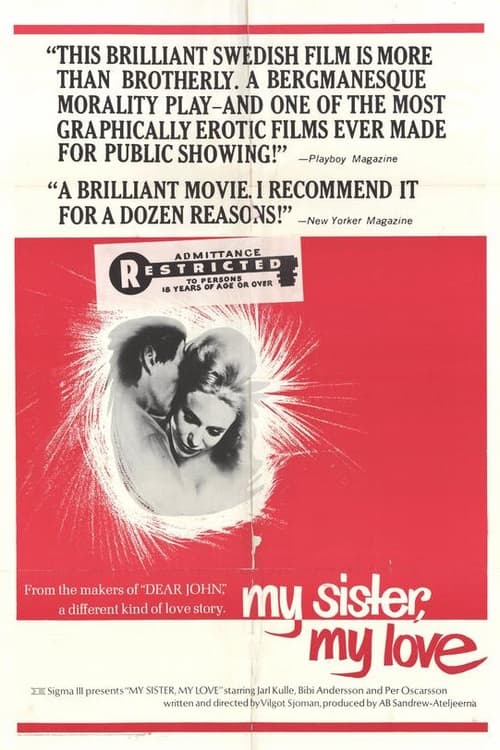 My Sister, My Love (1966)
 I (1966)
 Ön (1966)
 Sadist (1966)
 Yngsjömordet (1966)
 Hour of the Wolf (1968)
- More like this film, on a shelf you can walk up to.It's the lit case on the top shelf.