King Kong Escapes (1967)

- Original title
- キングコングの逆襲
- Directed by
- Ishirō Honda
- Genre
- fantasy film, horror film, science fiction film, kaiju, speculative fiction film
- Country
- United States, Japan
- Runtime
- 1h 44m
- Rated
- G
- Rating
- 6.2 of 10 from 113 voters
- Elsewhere
- IMDb
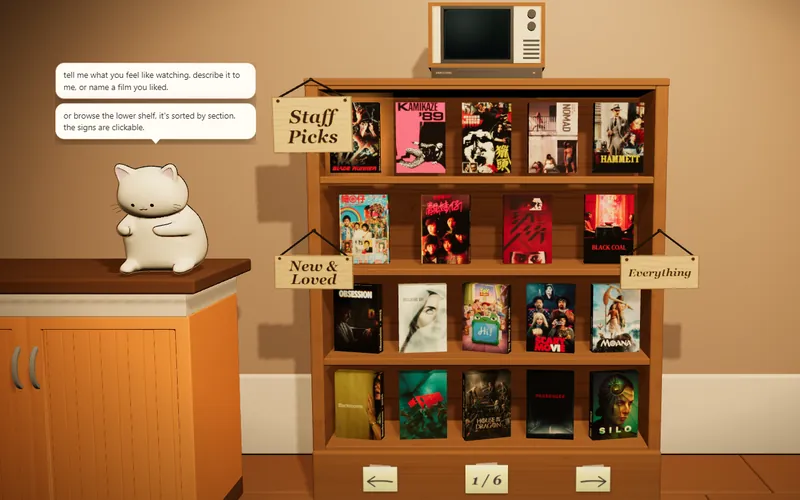
The catalogue in 3D
The film shelves have a room of their own that you can walk around in. The cat behind the counter is the AI Catbot, and they pick real films from the same catalogue when you tell them what you feel like watching. Nothing is for sale, here or in there. Go in from here and this film is already out on the counter, with more like it waiting on the shelf next to it.
How it feels
A giant robotic Kong called Mechani-Kong is built by a mad scientist to dig for a rare mineral. The real King Kong is captured and brought to Tokyo to fight the mechanical monster.
campyplayfulaction-packedlightheartedmonstrousretrofast-pacedcolorful
What happens
King Kong Escapes (Japanese: キングコングの逆襲, Hepburn: Kingu Kongu no Gyakushū; lit. 'King Kong's Counterattack') is a 1967 kaiju film directed by Ishirō Honda, with special effects by Eiji Tsuburaya. The film is a Japanese–American co-production between Toho and Rankin/Bass, and stars Rhodes Reason, Linda Miller, Akira Takarada, Mie Hama, Eisei Amamoto, with Haruo Nakajima as King Kong and Hiroshi Sekita as Mechani-Kong and Gorosaurus. The film is loosely based on Toei Animation's and Rankin/Bass' anime series The King Kong Show, and is the second and final Toho-produced film featuring King Kong, until its collaboration with Warner Bros. Pictures and Legendary Pictures on Godzilla vs. Kong (2021). King Kong Escapes, the fourth entry of the King Kong franchise, was released in Japan by Toho on July 22, 1967, and released in the United States by Universal Pictures on June 19, 1968, as Universal's second King Kong film. 37 years later, it was followed by the second remake of the 1933 film as the third and final King Kong film by Universal on December 14, 2005. (from Wikipedia, CC BY-SA)
More like this
 Son of Godzilla (1967)
 King Kong vs. Godzilla (1962)
 Kong: Skull Island (2017)
 Godzilla (1954)
 Gamera vs. Gyaos (1967)
 Godzilla vs. Mechagodzilla (1974)
 Gappa: The Triphibian Monster (1967)
 Godzilla vs. Mechagodzilla II (1993)
- More like this film, on a shelf you can walk up to.It's the lit case on the top shelf.