Wavelength (1967)

- Directed by
- Michael Snow
- Genre
- experimental film
- Country
- United States, Canada
- Runtime
- 44 min
- Rating
- 5.4 of 10 from 96 voters
- Elsewhere
- IMDb
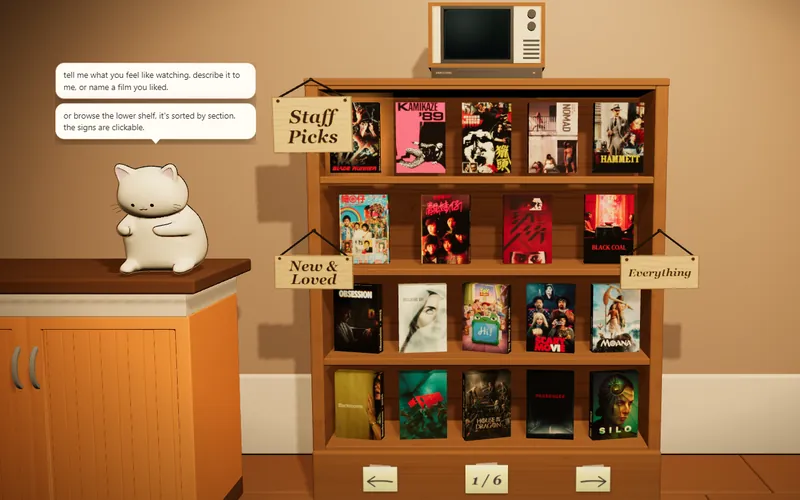
The catalogue in 3D
The film shelves have a room of their own that you can walk around in. The cat behind the counter is the AI Catbot, and they pick real films from the same catalogue when you tell them what you feel like watching. Nothing is for sale, here or in there. Go in from here and this film is already out on the counter, with more like it waiting on the shelf next to it.
How it feels
A single fixed camera slowly zooms across a loft space over 45 minutes. Brief events and people appear in the room while a sine wave tone rises in pitch.
slow-burnstatichypnoticminimalistausterecerebralunfoldingmeditative
What happens
Wavelength is a 1967 experimental film by Canadian artist Michael Snow. Shot from a fixed camera angle, it depicts a loft space with an extended zoom over the duration of the film. When making Wavelength, Snow had limited experience in film and was primarily known for his prior work in painting and sculpture. He shot the film in December 1966 over the course of a week, casting friends of his to appear in its brief narrative events. He experimented with mixed film stocks and other techniques that produced changes in the image's appearance. The film's soundtrack combines synchronized sound with sinusoidal output from an audio oscillator, which increases in pitch until the end of the film. Snow designed the original version of Wavelength for a limited release and first showed it at a private screening in May 1967. He submitted it to the 1967 Knokke-Le-Zoute Experimental Film Festival in Belgium, where it won the Grand Prix. Critics emphasized the film's presentation of continuous space and time during a period when experimental cinema was associated with rapid, fragmented editing. P. Adams Sitney identified it as a touchstone within the nascent structural film movement, and Scott MacDonald has recognized it as a landmark of avant-garde cinema. Snow went on to create a trilogy of "camera motion" films, which included the later films Back and Forth (1969) and La Région Centrale (1971). He revisited Wavelength in several of his later works, and it has served as an inspiration for other minimalist filmmakers and artists. (from Wikipedia, CC BY-SA)
More like this
 Gammelion (1967)
 Watching for the Queen (1973)
 10 Skies (2004)
 Opbrud (1970)
 Line Describing a Cone (1973)
 Landscape (1969)
 Runs Good (1971)
 Screen Test No. 1 (1965)
- More like this film, on a shelf you can walk up to.It's the lit case on the top shelf.