Branded to Kill (1967)

- Original title
- 殺しの烙印
- Directed by
- Seijun Suzuki
- Genre
- film noir, yakuza film, neo-noir
- Country
- Japan
- Runtime
- 1h 37m
- Rated
- 16
- Rating
- 7.2 of 10 from 258 voters
- Elsewhere
- IMDb

The catalogue in 3D
The film shelves have a room of their own that you can walk around in. The cat behind the counter is the AI Catbot, and they pick real films from the same catalogue when you tell them what you feel like watching. Nothing is for sale, here or in there. Go in from here and this film is already out on the counter, with more like it waiting on the shelf next to it.
How it feels
A contract killer takes on a seemingly impossible job from a mysterious woman. When the mission goes wrong, he finds himself hunted by a rival assassin who threatens his grip on reality.
absurdstylishtenseoffbeatdarkly comicsurrealunpredictablecool
What happens
Branded to Kill (Japanese: 殺しの烙印, Hepburn: Koroshi no Rakuin) is a 1967 Japanese black comedy and yakuza film directed by Seijun Suzuki and starring Joe Shishido, Koji Nanbara, Annu Mari and Mariko Ogawa. The story follows contract killer Goro Hanada as he is recruited by a mysterious woman named Misako for a seemingly impossible mission. When the mission fails, he is hunted by the phantom Number One Killer, whose methods threaten his life and sanity. Branded to Kill was designated by its production company and distributor, Nikkatsu, as a low-budget B movie. Dissatisfied with the original script, the studio called in Suzuki to rewrite and direct the film shortly prior to the start of production. Suzuki came up with many of his ideas for the project the night before or on the set while filming, and welcomed ideas from his colleagues; the screenplay is credited to Hachiro Guryu, a writing collective that consisted of Suzuki and seven other writers, including his frequent collaborators Takeo Kimura and Atsushi Yamatoya. Suzuki gave the film a satirical, anarchic and visually eclectic bent, from which the studio had previously warned him away. The brief turnaround Suzuki was given to make Branded to Kill meant that post-production on the film was completed only a day before its pre-scheduled release on June 15, 1967. The initial critical and commercial failure of Branded to Kill prompted Nikkatsu to ostensibly fire Suzuki for making "movies that make no sense and no money". In response, Suzuki successfully sued Nikkatsu, and garnered support from student groups, like-minded filmmakers and the general public, causing a major controversy throughout the Japanese film industry. Suzuki was blacklisted and did not make another feature film for a decade, but became a countercultural icon. By the 1980s, Branded to Kill had gained a strong international cult following; film critics and enthusiasts now regard it as an absurdist masterpiece. It has been cited as an influence by filmmakers such as Jim Jarmusch, John Woo, Park Chan-wook, Quentin Tarantino and Nicolas Winding Refn, and composer John Zorn. Branded to Kill inspired a loose 1973 Roman Porno remake directed by Yamatoya, Trapped in Lust, and a loose 2001 sequel, Pistol Opera, directed by Suzuki for Nikkatsu. The company has also hosted two major retrospectives spotlighting his career. (from Wikipedia, CC BY-SA)
More like this
 A Colt Is My Passport (1967)
 Aru koroshi ya (1967)
 High and Low (1963)
 Yogiri yo Kon'yamo Arigatō (1967)
 Le Samouraï (1967)
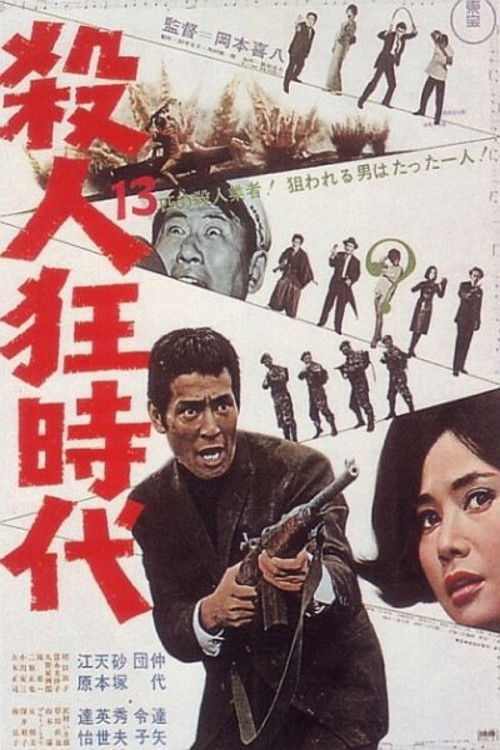 The Age of Assassins (1967)
 Slaughter Gun (1967)
 Immortal Guy (1967)
- More like this film, on a shelf you can walk up to.It's the lit case on the top shelf.