2001: A Space Odyssey (1968)
- Directed by
- Stanley Kubrick
- Written by
- Stanley Kubrick, Arthur C. Clarke
- Cast
- Keir Dullea, Gary Lockwood, William Sylvester, Leonard Rossiter, Margaret Tyzack, Robert Beatty, Sean Sullivan, Douglas Rain
- Genre
- epic film, mystery film, space adventure film, arthouse science fiction film
- Country
- United Kingdom, United States
- Runtime
- 2h 23m
- Rated
- G
- Rating
- 8.0 of 10 from 12,710 voters
- Elsewhere
- IMDb

The catalogue in 3D
The film shelves have a room of their own that you can walk around in. The cat behind the counter is the AI Catbot, and they pick real films from the same catalogue when you tell them what you feel like watching. Nothing is for sale, here or in there. Go in from here and this film is already out on the counter, with more like it waiting on the shelf next to it.
How it feels
Astronauts and scientists travel to Jupiter to investigate a mysterious alien monolith. Their voyage is overseen by the sentient computer HAL 9000.
slow-burncerebralvisually lushausteremeditativeunsettlingepicenigmatic
What happens
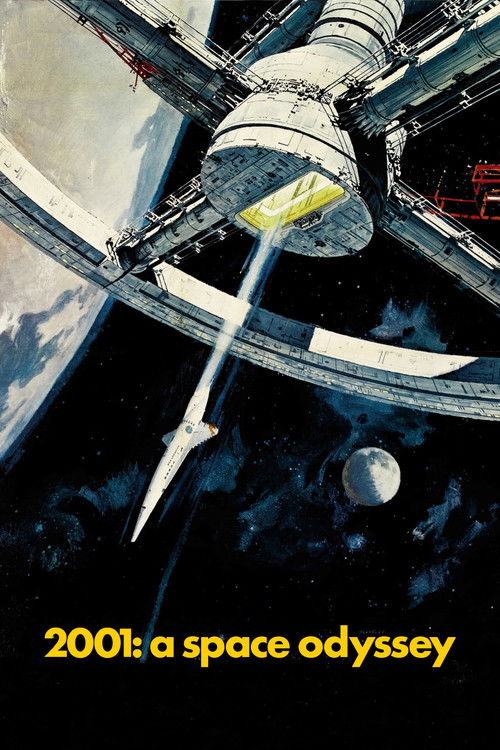
2001: A Space Odyssey is a 1968 epic science fiction film produced and directed by Stanley Kubrick, who co-wrote the screenplay with Arthur C. Clarke. Its plot was inspired by several short stories optioned from Clarke, primarily "The Sentinel" (1951) and "Encounter in the Dawn" (1953). The film stars Keir Dullea, Gary Lockwood, William Sylvester, and Douglas Rain, and follows a voyage by astronauts, scientists, and the sentient supercomputer HAL 9000 to Jupiter to investigate an alien monolith. The film is noted for its scientifically accurate depiction of spaceflight, pioneering special effects, and ambiguous themes. Kubrick avoided conventional cinematic and narrative techniques; dialogue is used sparingly, and long sequences are accompanied only by music. Shunning the convention that major film productions should feature original music, 2001: A Space Odyssey takes numerous works of classical music for its soundtrack, including pieces by Richard Strauss, Johann Strauss II, Aram Khachaturian, and György Ligeti. 2001: A Space Odyssey premiered at Uptown Theater on 2 April 1968 before being released by Metro-Goldwyn-Mayer on 3 April 1968 in the United States and 1 May 1968 in the United Kingdom. Polarising critics after its release, 2001: A Space Odyssey has since been subject to a variety of interpretations, ranging from the darkly apocalyptic to an optimistic reappraisal of the hopes of humanity. Critics noted its exploration of themes such as human evolution, technology, artificial intelligence, and the possibility of extraterrestrial life. It was nominated for four Academy Awards, winning Kubrick the award for his direction of the visual effects, the only Academy Award the director would receive. The film is widely regarded as one of the greatest and most influential films ever made. In 1991, it was selected by the United States Library of Congress for preservation in the National Film Registry. In 2022, 2001: A Space Odyssey placed in the top ten of Sight & Sound's decennial critics' poll, and topped their directors' poll. A sequel, 2010: The Year We Make Contact, was released in 1984 without Kubrick's involvement. (from Wikipedia, CC BY-SA)
More like this
 Planet of the Apes (1968)
 Doppelgänger (1969)
 Mission Mars (1968)
 The Magus (1968)
 Sphere (1998)
 Solaris (1968)
 Powers of Ten (1968)
 The Bamboo Saucer (1968)
- More like this film, on a shelf you can walk up to.It's the lit case on the top shelf.