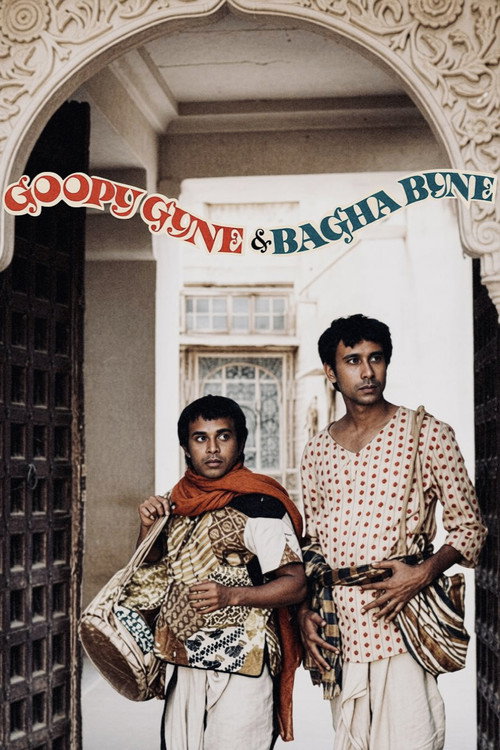
Goopy Gyne Bagha Byne (1968)
- Original title
- গুপী গাইন বাঘা বাইন
- Directed by
- Satyajit Ray
- Genre
- fantasy film, children's film
- Country
- India
- Runtime
- 1h 58m
- Rated
- U
- Rating
- 7.5 of 10 from 26 voters
- Elsewhere
- IMDb
The catalogue in 3D
The film shelves have a room of their own that you can walk around in. The cat behind the counter is the AI Catbot, and they pick real films from the same catalogue when you tell them what you feel like watching. Nothing is for sale, here or in there. Go in from here and this film is already out on the counter, with more like it waiting on the shelf next to it.
How it feels
A poor singer and a poor drummer get magical powers from a ghost king. They use their new abilities to help a kingdom in trouble.
whimsicalplayfulfantasticalmusicallightheartedcharmingcheerfuladventurous
What happens
Goopy Gyne Bagha Byne () is a 1969 Bengali satirical superhero film written and directed by Satyajit Ray and based on a story by his grandfather Upendrakishore Ray Chowdhury. It is a fantasy musical, with music and lyrics composed and written by Ray himself. This is the first film of the Goopy–Bagha series, and there are two sequels – Hirak Rajar Deshe, which was released in 1980, and Goopy Bagha Phire Elo, written by Satyajit Ray but directed by his son Sandip Ray, which was released in 1992. The film was based on the characters Goopy Gyne and Bagha Byne, who made their first appearance in the Sandesh magazine in 1915, with illustrations by Ray's grandfather Upendrakishore Ray Chowdhury. In 1961, after the revival of Sandesh, Ray began contemplating the idea of making a film based on that story, and he was partly compelled by his son Sandip to make a film which was less 'grim and adult'. This was matched by Ray's own desire to make a movie that, unlike his previous films, would cater to children. Plus, this would also give him an opportunity to lace the story with music and dancing, a point his movies' producers and distributors were always insisting upon. Ray managed to convince producers to finance the film, even though it was clear from the beginning that the film would cost a lot of money. The movie released to great critical and commercial reception, which held the record for longest continuous run of a Bengali-language movie in Bengal, as it ran for 51 straight weeks. It won the Best Feature Film and Best Direction awards at the 16th National Film Awards, and went on to win many other international awards as well. Critical reception was highly positive. Raja Sen called it to be the most innovative film to have ever come out of India. Phil Hall said that the film "comes as a delightful surprise – Ray, it appears, not only possessed a great sense of humor but also enjoyed a stunning talent for musical cinema". (from Wikipedia, CC BY-SA)
More like this
 Kakhano Megh (1968)
 Jagadeka Veeruni Katha (1961)
 Manassakshi (1968)
 Kannayya Kittayya (1993)
 Raja Aur Runk (1968)
 Neel Kamal (1968)
 Guruvunu Minchina Sishyudu (1963)
 Magic Ajji (2005)
- More like this film, on a shelf you can walk up to.It's the lit case on the top shelf.