The Milky Way (1969)
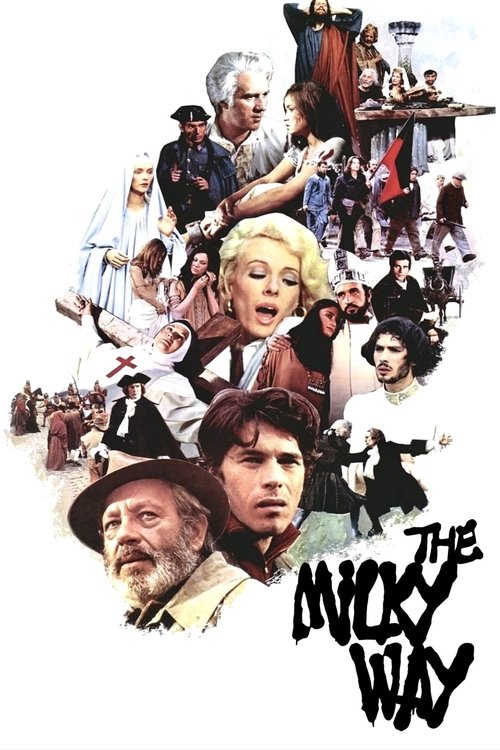
- Original title
- La Voie lactée
- Directed by
- Luis Buñuel
- Genre
- drama film, comedy film
- Country
- Germany, France, Italy
- Runtime
- 1h 37m
- Rated
- 14
- Rating
- 7.0 of 10 from 185 voters
- Elsewhere
- IMDb

The catalogue in 3D
The film shelves have a room of their own that you can walk around in. The cat behind the counter is the AI Catbot, and they pick real films from the same catalogue when you tell them what you feel like watching. Nothing is for sale, here or in there. Go in from here and this film is already out on the counter, with more like it waiting on the shelf next to it.
How it feels
Two vagabond travelers make a pilgrimage to Santiago de Compostela. Along the way they encounter bizarre incidents and characters from Christian history, including heretics and religious figures.
whimsicalsurrealwanderingphilosophicalsatiricalepisodicthought-provokingunpredictable
What happens
The Milky Way (French: La Voie lactée) is a 1969 surrealist comedy-drama film directed by Luis Buñuel. It stars Paul Frankeur, Laurent Terzieff, Denis Manuel, and Daniel Pilon, with Alain Cuny, Michel Piccoli, and Delphine Seyrig in supporting roles. Buñuel later called The Milky Way the first in a trilogy about "the search for truth", along with his subsequent films The Discreet Charm of the Bourgeoisie and The Phantom of Liberty. The title of the film is taken from a popular name used for the Camino de Santiago, a network of pilgrimage routes that stretched from northern Europe to Santiago de Compostela in Galicia, Spain, where the remains of St. James were reputed to be buried. The film follows the picaresque journey of two vagabond travelers (Frankeur and Terzieff), who seem to be making the pilgrimage as a means of escape. Along the way, they witness a series of bizarre incidents involving historical Christian heresies. At key moments, they encounter Jesus and the Virgin Mary, as well as modern believers and fanatics. The nonlinear plot functions as a highly symbolic travelogue across time and space, encompassing much of Christian history. While using satire to critique religion from a skeptical perspective, the film also explores the act of spiritual quest and search for meaning. The film originally met with limited success, but has come to be well-regarded amongst film enthusiasts and critics. (from Wikipedia, CC BY-SA)
More like this
 Love via the Side Door (1969)
 House of Pleasure (1969)
 How, When and with Whom (1969)
 Erotissimo (1969)
 Les Femmes (1969)
 Turistas y bribones (1969)
 El cronicón (1969)
 Satyricon (1969)
- More like this film, on a shelf you can walk up to.It's the lit case on the top shelf.