Double Vision (1971)

- Directed by
- Peter Campus
- Country
- United States
- Runtime
- 14 min
The catalogue in 3D
The film shelves have a room of their own that you can walk around in. The cat behind the counter is the AI Catbot, and they pick real films from the same catalogue when you tell them what you feel like watching. Nothing is for sale, here or in there. Go in from here and this film is already out on the counter, with more like it waiting on the shelf next to it.
How it feels
This is an experimental video by artist Peter Campus. It uses two video cameras to create double-exposure effects. The work is divided into seven sections, each exploring a different way of seeing.
experimentalmeditativecerebralintrospectivevisually abstractcontemplativedisorientingminimalist
What happens
Double Vision is one of the earliest and best known video works by American (born 1937) artist Peter Campus. Running 14 minutes and 22 seconds, it is a single channel video created with two video cameras fed through a mixer, providing the effect of a photographic double exposure. The video is divided into seven parts, each referencing a phenomenal mode of perception or form of biological sight. Each part utilizes a different configuration of the video cameras to record the interior of a small loft space. It opens with the title Double Vision superimposed over a photograph of a fundus (the back layer of the retina) taken through an ophthalmoscope. Campus described the video as "an exploration of double or two-camera images, relating to the evolution of sight in animals. The tape begins with an uncoordinated two-camera image and works its way up to an eye-brain model, always conscious of how this model differed from its subject matter." Campus's contemporary Bill Viola wrote in Art in America: "Unlike many of his contemporaries who used the surveillance camera as a detached, fixed observer documenting the performer’s actions, Campus assigned an active, independent ontological status to the camera eye." The room the video takes place in has also been said to take on the role of subject. Campus said in 2003, "When I was young I made myself a prisoner of my room. It became part of me, an extension of my being. I thought of the walls as my shell. The room as a container had some relationship to the imaginary space inside a monitor." (from Wikipedia, CC BY-SA)
More like this
 Doldertal 7 (1971)
 Straight and Narrow (1970)
 The End of a Love Affair
 Line Describing a Cone (1973)
 Toilette (1979)
 Soup (1975)
 Nebula 2 (1971)
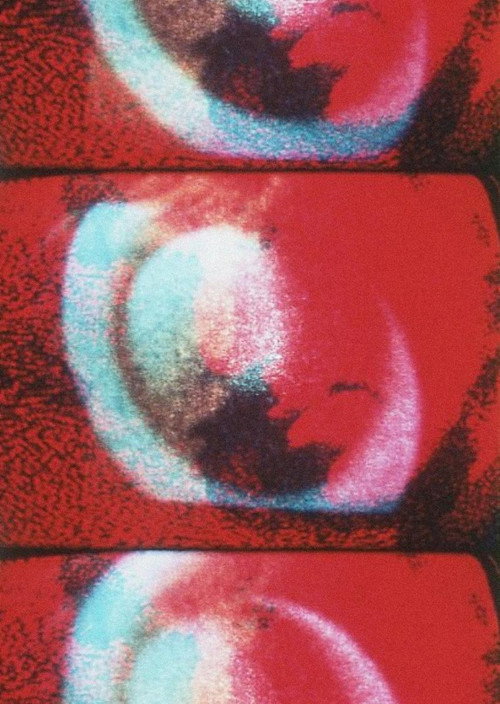 Video Selfportrait (1971)
- More like this film, on a shelf you can walk up to.It's the lit case on the top shelf.