The Social Seminar (1971)

- Genre
- documentary film
- Country
- United States
- Elsewhere
- IMDb
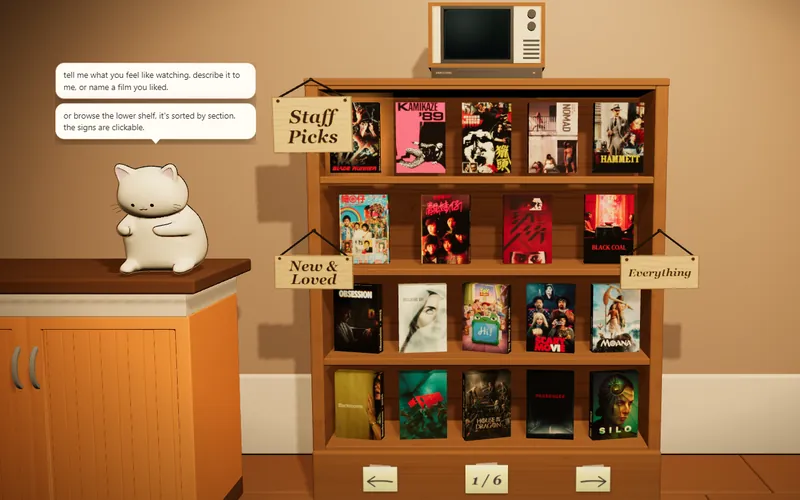
The catalogue in 3D
The film shelves have a room of their own that you can walk around in. The cat behind the counter is the AI Catbot, and they pick real films from the same catalogue when you tell them what you feel like watching. Nothing is for sale, here or in there. Go in from here and this film is already out on the counter, with more like it waiting on the shelf next to it.
How it feels
This is a series of educational films from 1971 about drugs, society, and education. It was made for the National Institute of Mental Health to train adults. The films cover topics like family, youth culture, and teaching approaches.
educationaldatedsoberinformativeslow-pacedacademicneutral
What happens
The Social Seminar is a series of educational films for adults produced by the Extension Media Center of the University of California at Los Angeles in 1971. The original full name of the series was "The Social Seminar: Education, Drugs, and Society." The series was executive produced by Gary Schlosser, an Oscar-nominated producer of short-subject documentaries. The films were distributed nationally, for example to state educational film offices. The series was produced for the National Institute of Mental Health as a "multi-media training series." Fifteen films were produced for The Social Seminar series: "Changing" (30 min., color), "The Family" (30 min., B&W), "News Story" (30 min., color), "Youth Culture Series" (1 hr., color), "Drugs and Beyond" (30 min., color), "Brian at Seventeen" (30 min., B&W), "Jordan Paul: One Teacher's Approach" (30 min., B&W), "What is Teaching? What is Learning?" (30 min., color), "Mr. Edler's Class: Drug Education at the Elementary Level" (30 min., color), "Drug Talk: Some Current Drug Programs (30 min., color), "Understanding: A New Institution" (6 min., B&W), "Community in Quest" (30 min., color), and "Meeting" (30 min., B&W). The longest film, the hour-long "Youth Culture Series," consisted of four segments each focusing on a specific young adult; these segments were named "Guy," "Bunny," "Tom," and "Teddy." The first nine films in the series depict, in a cinema-verite style without voiceover or introduction, aspects of the lives of a selected person or family as they dealt with personal, interpersonal, and societal change. For example, the film "Changing" shows how one man's reevaluation of his life and social standing led to his becoming a "hippie" in the eyes of his family and coworkers; though his home life was enhanced, he found himself increasingly socially isolated. The remaining six films focus on various ways that educators, families, and communities attempt to solve societal problems. Several of the films are part of the Prelinger Archive and are available freely online. In June 2011, "Changing" was featured on the Turner Classic Movies series TCM Underground. (from Wikipedia, CC BY-SA)
More like this
 Growing Up Female (1971)
 The Distant Drummer (1970)
 Naughty! (1971)
 Stof (1971)
 Running Shadow (1971)
 Sæt barnet på plads (1971)
 The Beguiled: The Storyteller (1971)
 The Numbers Start with the River (1971)
- More like this film, on a shelf you can walk up to.It's the lit case on the top shelf.