Enough Praying (1972)
- Original title
- Ya no basta con rezar
- Directed by
- Aldo Francia
- Genre
- drama film
- Country
- Chile
- Runtime
- 1h 27m
- Rating
- 7.5 of 10 from 11 voters
- Elsewhere
- IMDb
The catalogue in 3D
The film shelves have a room of their own that you can walk around in. The cat behind the counter is the AI Catbot, and they pick real films from the same catalogue when you tell them what you feel like watching. Nothing is for sale, here or in there. Go in from here and this film is already out on the counter, with more like it waiting on the shelf next to it.
How it feels
A priest in 1960s Chile is torn between following church rules and joining a workers' revolution in the port of Valparaíso. He deals with poverty and social unrest during a time of political turmoil.
conflictedpolitically chargedcontemplativeurgentgrittyserioustense
What happens
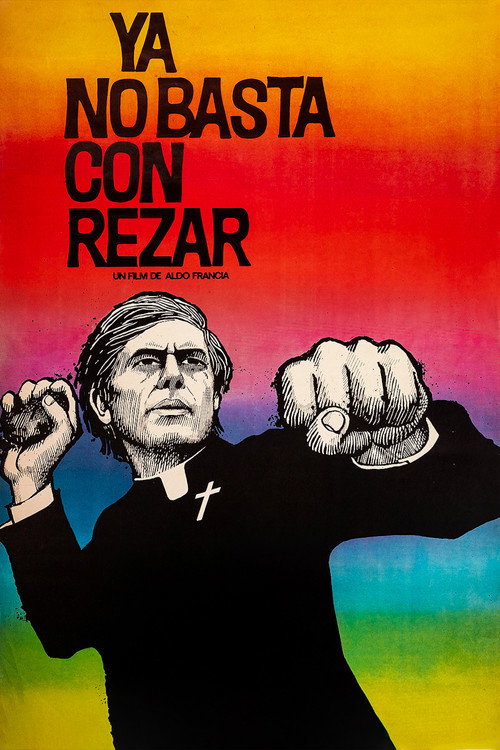
Enough Praying (Spanish: Ya no basta con rezar) is a 1973 Chilean drama film directed by Aldo Francia. The film tells the story of a priest facing poverty and social disorders that occurred during the presidency of Eduardo Frei Montalva. The protagonist, Father Jaime (The Priest), must constantly struggle between his obedience to the hierarchy of the Church and his desire to take a more active role in the workers' revolution that is being planned in the port of Valparaíso in 1967. The promotional poster for the film was quite controversial at the time since it portrays a priest holding his left hand and about to throw a stone with the other hand, with the apparent intent of instigating a violent rebellion. The context of the film's release was within a period of rapidly increasing political polarization and economic instability in Chile, with some fears of a potential breakout of civil war and the collapse of civil society. Given the film's portrayal of the struggles of the working class, it was part of a long list of media that was heavily censored by the military dictatorship after the 1973 Chilean coup d'etat. Today the protagonist's pose is reflected in reproductions of the poster in different stencils and street graffiti across Santiago. (from Wikipedia, CC BY-SA)
More like this
 Metamorfosis del jefe de la policía política (1973)
 El realismo socialista (1973)
 The Expropriation (1972)
 Operation Alfa (1972)
 Valparaíso mi amor (1969)
 Machuca (2004)
 ¡Qué hacer! (1970)
 Cuando despierta el Pueblo (1973)
- More like this film, on a shelf you can walk up to.It's the lit case on the top shelf.