Barricades (1972)

- Original title
- מתרסים
- Directed by
- Ram Loevy
- Genre
- documentary film
- Country
- Israel
- Runtime
- 1h 01m
- Rating
- 10.0 of 10 from 1 voters
- Elsewhere
- IMDb
The catalogue in 3D
The film shelves have a room of their own that you can walk around in. The cat behind the counter is the AI Catbot, and they pick real films from the same catalogue when you tell them what you feel like watching. Nothing is for sale, here or in there. Go in from here and this film is already out on the counter, with more like it waiting on the shelf next to it.
How it feels
This documentary follows two families, one Jewish and one Palestinian, who each lost a child in the 1948 war. It shows how the war is remembered differently by both sides. The film was controversial for being the first to show these personal losses to a broad Israeli audience.
soberintimatepoignantrestrainedbittersweetthoughtfulhumanizingquiet
What happens
Barricades (Hebrew: מיתרסים, Mitrasim) was one of the first documentary films created for Israeli television. It tells the story of two families, one Jewish and the other Palestinian, who both lost children during the 1948 Arab-Israeli War, known to Palestinians as the 1948 Palestinian expulsion and flight, the Naqba, or "Catastrophe." The film, directed by Ram Loevy, caused considerable controversy when it aired on 1 August 1972. It was the first time that an Arab viewer had a chance through an Israeli film to experience the emotional significance of the Holocaust for Jews, and it was also the first time that Israeli Jews had an opportunity to experience the emotional significance of the Naqba to the Palestinian people. Loevy first came up with the idea behind the documentary in 1968, while studying film in London. As a Hebrew-language broadcaster for the BBC, he had proposed creating a documentary about the social rifts tearing at Israeli society, with one episode focusing on the conflict between Jews and Palestinians. Although the BBC expressed interest in the project, Loevy returned to Israel soon after to help launch Channel 1, the country's first attempt at television broadcasting. He did not, however, abandon the idea, albeit in a more reduced format. Back in Israel, Loevy pitched the idea to the Israel Broadcasting Authority, which agreed to fund the project. At the time, Professor Eliyahu Katz, one of the founders of Israeli television, explained that the idea fulfilled one of the major purposes for which television was brought to Israel: to strengthen ties between the Jewish and Arab residents of the country. Loevy made the film in 1969. The plotline focused on two families: the Shevat family of Haifa, which had lost two sons in battle during the War of Independence, and the family of Hussein Abu-Muhammad Yehia of the Jalazoon refugee camp near Ramallah, who lost two sons when the family fled from their ancestral home in the town of Ramla. For over two decades, the families had been trapped in the past, still mourning their two sons. Though Israel was then living in the shadow of the Six-Day War, Loevy made a conscious decision to base his story on 1948, explaining, "We focused on that year in order to push the testimonies back into the past. The two families in the film never meet; instead, a visit to the graves and a visit to the ruins of the Arab village are juxtaposed. By the time the film was finished, however, Israel was engaged in a brutal War of Attrition with its neighbors, and several new Palestinian guerrilla factions were taking up the armed struggle against Israel as a means of achieving self-determination. Focusing on the tragedy of the Palestinian people would, it was believed, only incite further violence. The film was shelved for three years, and only aired on 1 August 1972. The decision to finally air Barricades was made by Yeshayahu Tadmor, who had recently been appointed by the government to head Israeli television. In an interview with the Israeli newspaper Yediot Ahronot he said that if the War of Attrition had still been raging, he would not have screened it either. Yet even Tadmor's decision's was guarded. He agreed to screen Barricades, but only as part of a popular talk show, The Third Hour, so that the content could be discussed by a panel of "experts," which would ideally include both Arabs and Jews. Only Jews participated, however. One Arab guest, Muhammad Ali Ja'abari, mayor of Hebron and a Jordanian parliamentarian, refused to participate. At the same time, Israel's Foreign Minister Abba Eban refused to appear with a second guest, Anwar Nusseibeh, former Jordanian defense minister and governor of Jerusalem. In the end, none of them participated, and the Director General of the IBA Shmuel Almog decided not to replace them. An editorial published in the newspaper Maariv two days after Barricades was aired noted that in the end, the ensuing discussion was unbalanced. Not only did the film (from Wikipedia, CC BY-SA)
More like this
 Lullaby (2004)
 Ben Gurion Zoher (1972)
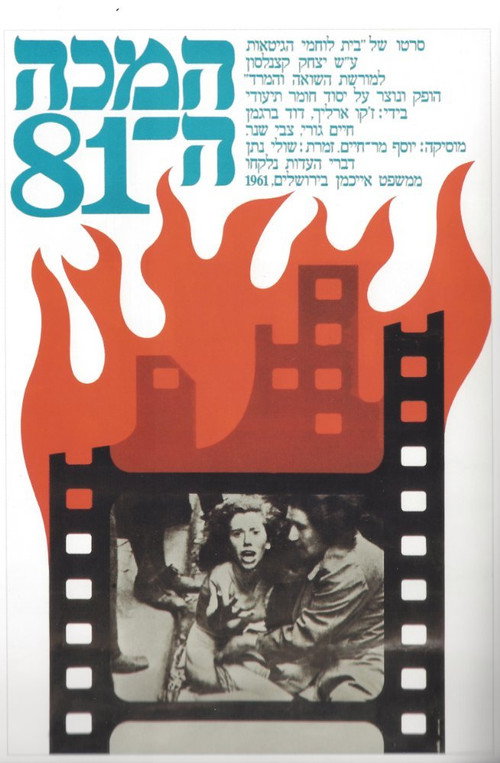 The 81st Blow (1974)
 Out of Evil (1947)
 Neither by Day Nor by Night (1972)
 But Where Is Daniel Wax? (1972)
 The Skies are Closer in Homesh (2004)
 Judgement Day (1974)
- More like this film, on a shelf you can walk up to.It's the lit case on the top shelf.