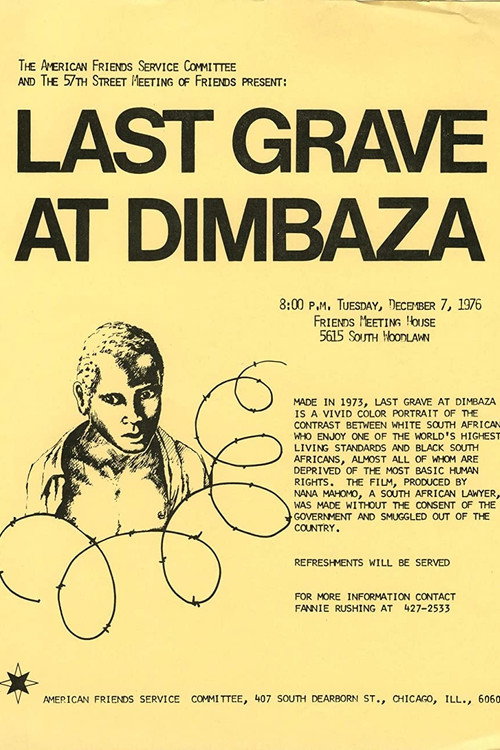
Last Grave at Dimbaza (1974)
- Original title
- The Last Grave at Dimbaza
- Directed by
- Nana Mahome, Chris Curling, Pascoe Macfarlane
- Genre
- documentary
- Country
- United Kingdom, South Africa
- Runtime
- 55 min
- Elsewhere
- IMDb
The catalogue in 3D
The film shelves have a room of their own that you can walk around in. The cat behind the counter is the AI Catbot, and they pick real films from the same catalogue when you tell them what you feel like watching. Nothing is for sale, here or in there. Go in from here and this film is already out on the counter, with more like it waiting on the shelf next to it.
How it feels
This documentary shows the huge gap in living conditions between white and black people in South Africa under apartheid. It was filmed secretly because of the country's strict laws, and it helped expose the government's brutal resettlement policy to the world.
documentaryeye-openingsoberingeducationallow-keystraightforwardfact-basedlow-budget
What happens
Last Grave at Dimbaza is a 1974 documentary film made by South African and young British film-makers who wanted to document Apartheid in South Africa. The same team had previously made the film End of the Dialogue. Because of South Africa's restrictive laws governing what could be photographed, the film had to be shot clandestinely and smuggled out of the country, where it was edited and released in England. The film won the Grand Prix award for Short Film at the Melbourne International Film Festival in 1975. The film highlighted the disparity in living conditions between white and black people in South Africa, revealing that this has been enshrined in numerous South African laws. While white people enjoyed one of the highest standards of living in the world, the lives of black people were carefully circumscribed so that they enjoyed few rights with no legal recourse. Most lived in poverty. When the film was released, it resulted in international condemnation of the Apartheid government's brutal resettlement policy, which had not been widely known outside of South Africa prior to that point. (from Wikipedia, CC BY-SA)
More like this
 End of the Dialogue (1970)
 Dans van die Flamink (1974)
 Les Bicots-nègres, vos voisins (1974)
 The Heart of Whiteness (2005)
 Allein machen sie dich ein (1974)
 Born into Struggle (2004)
 Animals Are Beautiful People (1974)
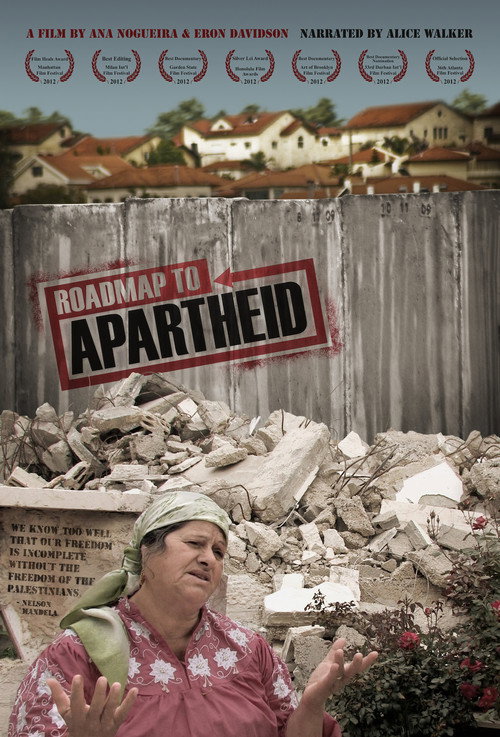 Roadmap to Apartheid (2012)
- More like this film, on a shelf you can walk up to.It's the lit case on the top shelf.