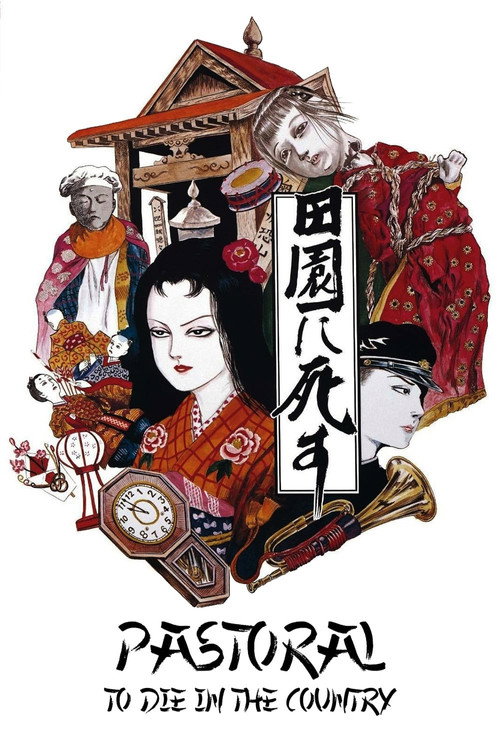
Pastoral: To Die in the Country (1974)
- Original title
- 田園に死す
- Directed by
- Shūji Terayama
- Genre
- drama film
- Country
- Japan
- Runtime
- 1h 44m
- Rating
- 7.5 of 10 from 107 voters
- Elsewhere
- IMDb

The catalogue in 3D
The film shelves have a room of their own that you can walk around in. The cat behind the counter is the AI Catbot, and they pick real films from the same catalogue when you tell them what you feel like watching. Nothing is for sale, here or in there. Go in from here and this film is already out on the counter, with more like it waiting on the shelf next to it.
How it feels
An adult film director tries to make a movie about his childhood in the countryside but his younger self resists and fights against his vision. The film blends memory and imagination as past and present collide.
surrealdreamlikeunsettlingnostalgicexperimentaldisorientingintrospectivefragmented
What happens
Pastoral: To Die in the Country (Japanese: 田園に死す, Hepburn: Den-en ni shisu; lit. 'To Die in the Countryside'), also known as Pastoral Hide and Seek (French: Cache-cache pastoral), is a 1974 Japanese experimental surrealist film written and directed by Shūji Terayama. Adapted from Terayama's 1965 tanka poetry collection and a 1962 television drama he scripted—both sharing the film's Japanese title—the film stars Kantarō Suga, Hiroyuki Takano, Kaoru Yachigusa, and Isao Kimura. Employing a film-within-a-film structure, it depicts an adult director (Suga)—a stand-in for Terayama—who encounters resistance from his younger self (Takano) as he attempts to complete a cinematic reimagining of his rural adolescence. Pastoral was released in Japan on December 28, 1974. Co-produced by Art Theatre Guild and Terayama's independent production company Jinriki Hikōki Sha, both parties split the film's budget equally as part of ATG's 10-million-yen film initiative. Terayama, a prominent fixture of the underground (angura) scene, employed members of his avant-garde theatre troupe Tenjō Sajiki as cast and crew, including J. A. Seazer, who composed the film's psychedelic rock score. The film was distributed exclusively through ATG's dwindling network of art house cinemas, resulting in a limited domestic theatrical release. It was entered into the 1975 Cannes Film Festival, where it was nominated for the Palme d'Or. (from Wikipedia, CC BY-SA)
More like this
 Bitterness of Youth (1974)
 It Was a Faint Dream (1974)
 Virgin Blues (1974)
 The Oldest Profession (1974)
 Red Paper Lantern (1974)
 Dear Summer Sister (1974)
 The Homeless (1974)
 Extreme Private Eros: Love Song 1974 (1974)
- More like this film, on a shelf you can walk up to.It's the lit case on the top shelf.