Barry Lyndon (1975)

- Directed by
- Stanley Kubrick
- Genre
- drama film, adventure film, war film, period drama film, comedy drama, historical film
- Country
- United Kingdom, United States
- Runtime
- 3h 04m
- Rated
- PG
- Rating
- 8.0 of 10 from 3,215 voters
- Elsewhere
- IMDb
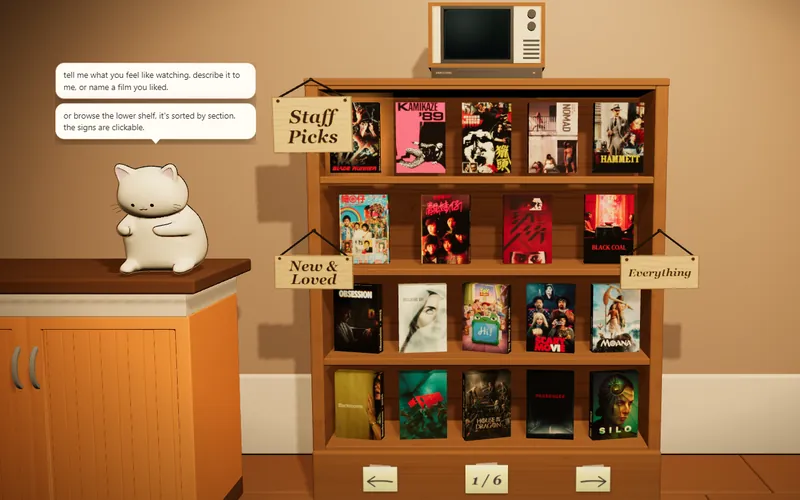
The catalogue in 3D
The film shelves have a room of their own that you can walk around in. The cat behind the counter is the AI Catbot, and they pick real films from the same catalogue when you tell them what you feel like watching. Nothing is for sale, here or in there. Go in from here and this film is already out on the counter, with more like it waiting on the shelf next to it.
How it feels
An 18th century Irish rogue tries to rise from poverty into the aristocracy by seducing and marrying a wealthy widow. The film follows his early successes and his eventual downfall.
slowdeliberatedetachedvisually beautifulmelancholicelegiacbittersweetformalmeasured
What happens
Barry Lyndon is a 1975 epic historical drama film written, directed, and produced by Stanley Kubrick, based on the 1844 novel The Luck of Barry Lyndon by William Makepeace Thackeray. Narrated by Michael Hordern, and starring Ryan O'Neal, Marisa Berenson, Patrick Magee, Leonard Rossiter, and Hardy Krüger, the film recounts the early exploits and later unravelling of an 18th-century Irish rogue and gold digger who marries a rich widow in order to attempt to climb the social ladder and assume her late husband's aristocratic position. Kubrick began production on Barry Lyndon after his 1971 film A Clockwork Orange. He had originally intended to direct a biopic on Napoleon, but lost his financing because of the commercial failure of the similar 1970 Dino De Laurentiis–produced Waterloo. Kubrick eventually directed Barry Lyndon, set partially during the Seven Years' War, utilising his research from the Napoleon project. Filming began in December 1973 and lasted roughly eight months, taking place in England, Ireland, and Germany. The film's cinematography has been described as ground-breaking. Especially notable are the long double shots, usually ended with a slow backwards zoom, the scenes shot entirely in candlelight, and the settings based on William Hogarth paintings. The exteriors were filmed on location in England, Ireland, and Germany, with the interiors shot mainly in London. The production had problems related to logistics, weather, and politics (Kubrick feared that he might be an IRA hostage target). Barry Lyndon won four Oscars at the 48th Academy Awards: Best Scoring: Original Song Score and Adaptation or Scoring: Adaptation, Best Costume Design, Best Art Direction, and Best Cinematography, while Kubrick himself was nominated for Best Picture, Best Director and Best Adapted Screenplay. Although some critics took issue with the film's slow pace and restrained emotion, its reputation, like that of many of Kubrick's works, has grown over time, and it is widely considered one of the greatest films of all time. In the 2022 Sight & Sound Greatest Films of All Time poll, Barry Lyndon placed 12th in the directors' poll and 45th in the critics' poll. (from Wikipedia, CC BY-SA)
More like this
 Royal Flash (1975)
 The Count of Monte Cristo (1975)
 Pride & Prejudice (2005)
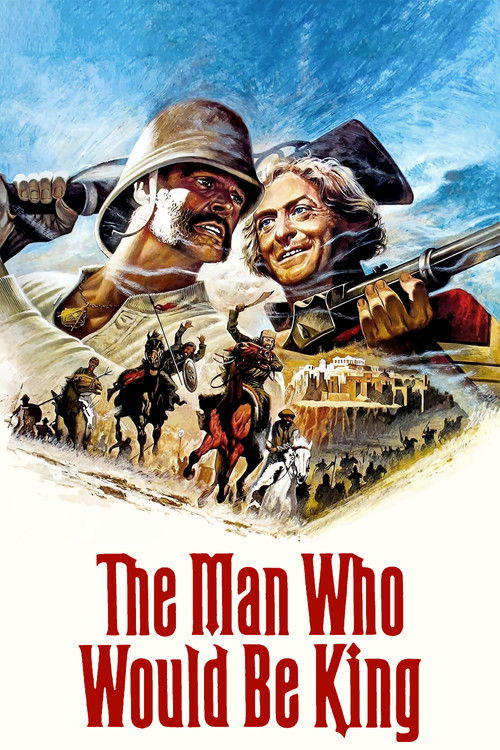 The Man Who Would Be King (1975)
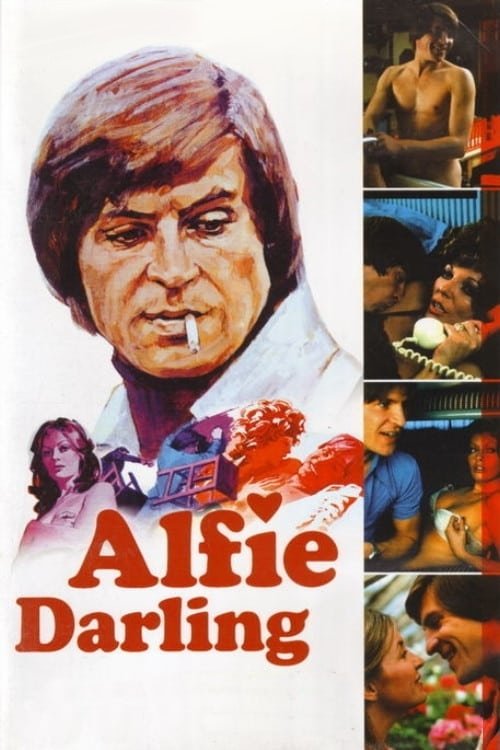 Alfie Darling (1975)
 Lloyd George Knew My Father (1975)
 A Journey to London (1975)
 The Professor and the Madman (2019)
- More like this film, on a shelf you can walk up to.It's the lit case on the top shelf.