The Mirror (1975)

- Original title
- Зеркало
- Directed by
- Andrei Tarkovsky
- Genre
- drama film, biographical film, experimental film
- Country
- Soviet Union
- Runtime
- 1h 48m
- Rated
- NR
- Rating
- 8.0 of 10 from 1,099 voters
- Elsewhere
- IMDb
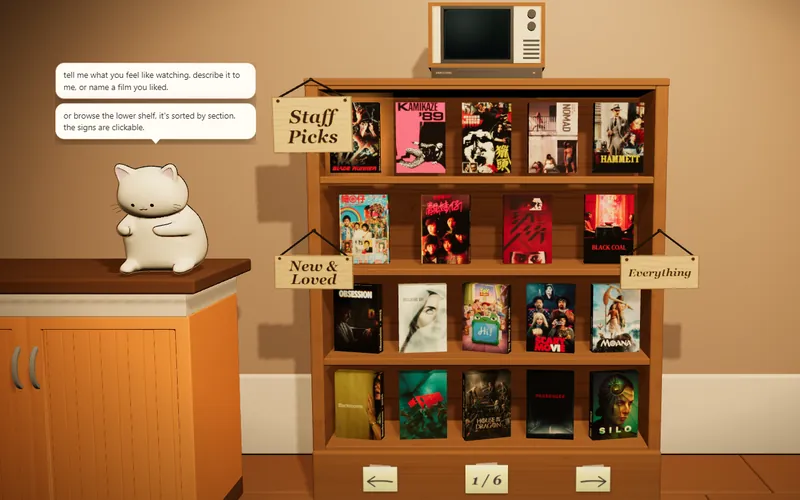
The catalogue in 3D
The film shelves have a room of their own that you can walk around in. The cat behind the counter is the AI Catbot, and they pick real films from the same catalogue when you tell them what you feel like watching. Nothing is for sale, here or in there. Go in from here and this film is already out on the counter, with more like it waiting on the shelf next to it.
How it feels
A dying poet reflects on his childhood, his family, and his memories. The film blends personal moments with historical footage from Soviet history.
dreamlikepoeticmelancholicnonlinearmeditativeintimatepersonalnostalgic
What happens
Mirror (Russian: Зеркало, romanized: Zerkalo) is a 1975 Soviet avant-garde drama film directed by Andrei Tarkovsky and written by Tarkovsky and Aleksandr Misharin. The film features Margarita Terekhova, Ignat Daniltsev, Alla Demidova, Anatoly Solonitsyn, Tarkovsky's wife Larisa Tarkovskaya, and his mother Maria Vishnyakova. Innokenty Smoktunovsky contributed voiceover dialogue and Eduard Artemyev composed incidental music and sound effects. Mirror portrays a dying poet pondering his memories. It is loosely autobiographical, unconventionally structured, and draws on a wide variety of source material, including newsreel footage of major moments in Soviet history and the poetry of the director's father, Arseny Tarkovsky. Its cinematography slips between color, black-and-white, and sepia, and is told through a nonlinear narrative. The film's loose flow of oneiric images has been compared with the stream of consciousness technique associated with modernist literature. Mirror initially polarized critics, audiences, and the Soviet film establishment. Tarkovsky devised the original concept in 1964, but the Soviet government did not approve funding for the film until 1973 and limited the film's release amid accusations of “cinephilic elitism”. Many viewers found its narrative incomprehensible, although Tarkovsky noted that many non-film critics understood the film. Since its release, it has been reappraised as Tarkovsky's magnum opus and one of the greatest films of all time. It is especially popular with Russians, for many of whom it is the most beloved of Tarkovsky's works. (from Wikipedia, CC BY-SA)
More like this
 Take Aim (1975)
 The Theater Is My House (1975)
 To Dream and to Live (1975)
 Rasskaz o prostoy veshchi (1975)
 Don't Believe that I'm No Longer Here (1975)
 Earthly Love (1975)
 What the Stands Won't Know (1975)
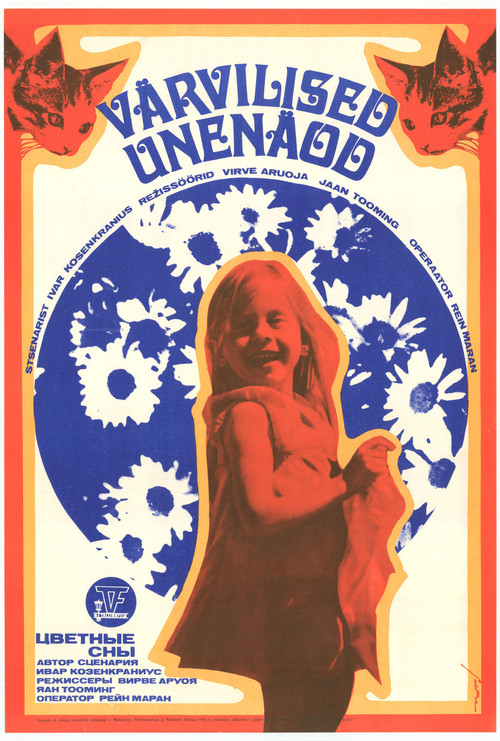 Colourful Dreams (1975)
- More like this film, on a shelf you can walk up to.It's the lit case on the top shelf.