The Hindenburg (1975)

- Directed by
- Robert Wise
- Genre
- drama film, disaster film
- Country
- United States
- Runtime
- 2h 05m
- Rated
- PG
- Rating
- 6.3 of 10 from 153 voters
- Elsewhere
- IMDb
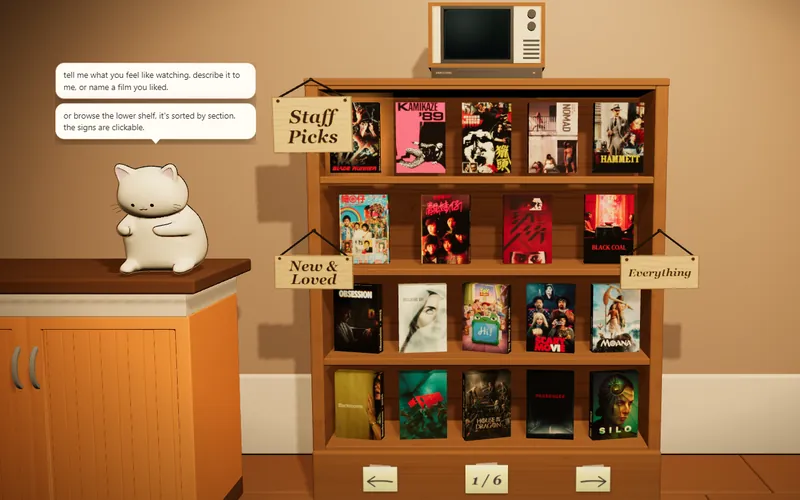
The catalogue in 3D
The film shelves have a room of their own that you can walk around in. The cat behind the counter is the AI Catbot, and they pick real films from the same catalogue when you tell them what you feel like watching. Nothing is for sale, here or in there. Go in from here and this film is already out on the counter, with more like it waiting on the shelf next to it.
How it feels
This film imagines a conspiracy theory where sabotage caused the Hindenburg airship disaster in 1937. It follows investigators and passengers aboard the zeppelin before the explosion. The story is a dramatized take on what might have led to the tragedy.
tragictensetheoreticaldramaticretrospeculativesuspensefuldisaster-adjacent
What happens
The Hindenburg is a 1975 American Technicolor disaster film based on the 1937 Hindenburg disaster. The film stars George C. Scott, Anne Bancroft and William Atherton and was produced and directed by Robert Wise. The screenplay was by Nelson Gidding, Richard Levinson and William Link, based on the 1972 book of the same name by Michael M. Mooney. A highly speculative thriller, the film and the book on which it is based depict a conspiracy involving sabotage, which leads to the destruction of the German airship Hindenburg. In reality, while the Zeppelins were certainly used as propaganda symbols by Nazi Germany, and anti-Nazi forces may have been motivated to sabotage them, the possibility of such an act was investigated at the time; ultimately, no firm evidence was uncovered to substantiate the theory. A. A. Hoehling, author of the 1962 book Who Destroyed the Hindenburg?, also about the sabotage theory, sued Mooney along with the film developers for copyright infringement as well as unfair competition. However, Judge Charles M. Metzner dismissed his allegations. Filmed largely in color (with a mock newsreel presented in black-and-white at the beginning of the film), a portion of the film is presented in monochrome, edited between portions of the historical Hindenburg newsreel footage shot on May 6, 1937. (from Wikipedia, CC BY-SA)
More like this
 Hindenburg disaster newsreel footage (1937)
 Hindenburg: The Untold Story (2007)
 Hindenburg (2011)
 Murder on Flight 502 (1975)
 LH 615 – Operation München (1975)
 Airport '77 (1977)
 Sinking of the Lusitania: Terror at Sea (2007)
 Apollo 13 (1995)
- More like this film, on a shelf you can walk up to.It's the lit case on the top shelf.