Inchon (1981)

- Directed by
- Terence Young
- Genre
- drama film, war film
- Country
- United States
- Runtime
- 2h 20m
- Rated
- PG
- Rating
- 3.9 of 10 from 15 voters
- Elsewhere
- IMDb
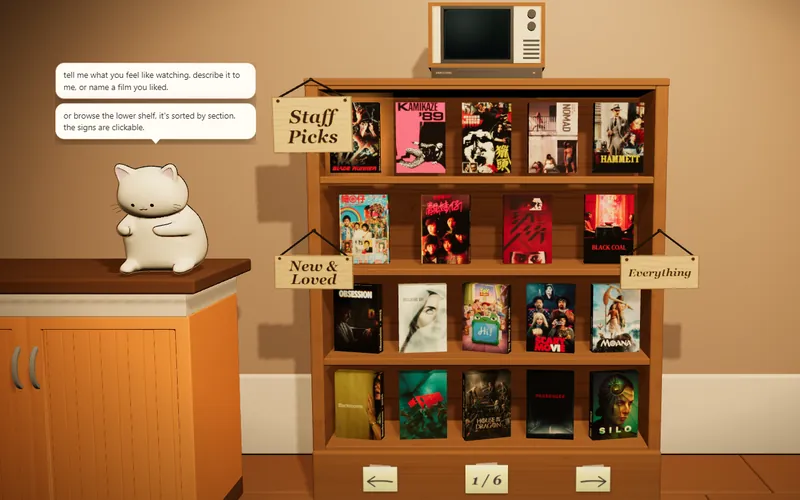
The catalogue in 3D
The film shelves have a room of their own that you can walk around in. The cat behind the counter is the AI Catbot, and they pick real films from the same catalogue when you tell them what you feel like watching. Nothing is for sale, here or in there. Go in from here and this film is already out on the counter, with more like it waiting on the shelf next to it.
How it feels
A war film about the 1950 Battle of Inchon during the Korean War. It follows General Douglas MacArthur as he plans a surprise amphibious landing to turn the tide of the conflict.
epicdramatichistoricalpatrioticintimateslow-pacedmilitary-focusedwar-torn
What happens
Inchon (also stylized as Inchon!) is a 1981 war film about the Battle of Inchon, considered to be the turning point of the Korean War. Directed by Terence Young and financed by Unification movement founder Sun Myung Moon, the film stars Laurence Olivier as General Douglas MacArthur, who planned the surprise amphibious landing at Incheon, South Korea, in 1950, with Jacqueline Bisset, Ben Gazzara, Toshiro Mifune and Richard Roundtree. Inchon's plot includes both military action and human drama. The film concludes with the United Nations victory over North Korean forces in the Battle of Inchon, which is considered to have saved South Korea. Costing $46 million, with filming taking place in South Korea, California, Italy, Ireland and Japan, the production encountered many problems, including a typhoon and the death of cast member David Janssen. Both the Unification movement and the United States military provided extras during the filming. After premiering in May 1981, the film was not released theatrically in the United States and Canada until September 1982, and was quickly withdrawn due to its critical and box office failure. It never received a home video release, but has occasionally been broadcast on television. It incurred the greatest financial loss of any film released in 1982, earning less than $2 million against its lofty budget, resulting in a deficit of around $41 million. Reviews at the time were consistently negative, and later commentators, including Newsweek, TV Guide and The Canadian Press, have classed Inchon among the worst films of all time. (from Wikipedia, CC BY-SA)
More like this
 MacArthur (1977)
 Abengo Airborne Corps (1982)
 Letters from Iwo Jima (2006)
 Imperial Navy (1981)
 War Is Hell (1961)
 A Battle Journal (1981)
 The Glory Brigade (1953)
 Guerilla at the Philippines (1981)
- More like this film, on a shelf you can walk up to.It's the lit case on the top shelf.