Archa bláznů (1990)
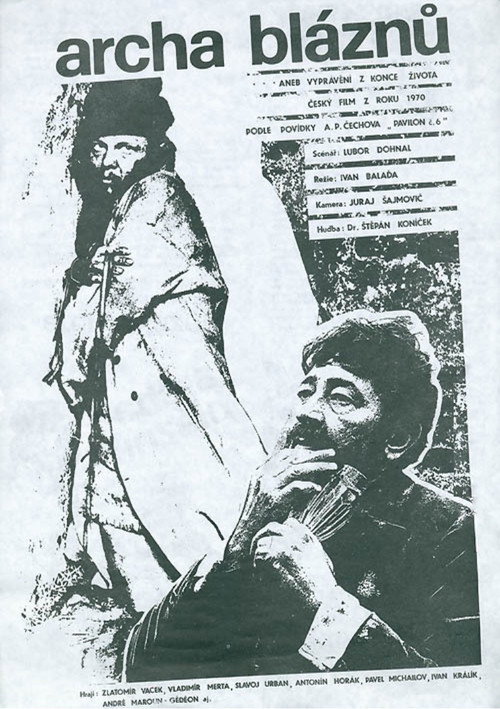
- Original title
- Archa bláznů aneb Vyprávění z konce života
- Directed by
- Ivan Balaďa
- Genre
- drama film, parable
- Country
- Czechoslovakia
- Runtime
- 1h 45m
- Rating
- 2.0 of 10 from 1 voters
- Elsewhere
- IMDb
The catalogue in 3D
The film shelves have a room of their own that you can walk around in. The cat behind the counter is the AI Catbot, and they pick real films from the same catalogue when you tell them what you feel like watching. Nothing is for sale, here or in there. Go in from here and this film is already out on the counter, with more like it waiting on the shelf next to it.
How it feels
A film adaptation of a Chekhov story about life inside a mental institution. It follows the experiences of patients and staff in a confined setting that reflects broader societal constraints.
darkoppressiveslow-burnmelancholicbleakcerebralclaustrophobicunsettling
What happens
Archa bláznů (littéralement en français L'Arche des fous) est le premier long métrage du réalisateur Ivan Balaďa (cs). Filmé d'après la nouvelle d'Anton Tchekhov, Pavillon no 6 (Écrou no 6 dans certaines traductions), il est tourné en 1970, mais n'est sorti en salles qu'en 1990, après la Révolution de Velours en Tchécoslovaquie. La base et l'intemporalité du thème sont l'œuvre de Tchekhov, mais l'aspect formel et visuel et surtout la forme cinématographique du film ont été fournis notamment par le réalisateur Ivan Balaďa, le directeur de la photographie Juraj Šajmovič (cs) et le scénariste Lubor Dohnal (cs), qui ont enrichi l'histoire de plusieurs épisodes avec des personnages secondaires, que l'écrivain lui-même ne mentionnait que brièvement dans sa nouvelle. Parabole cinématographique, le film n'a reçu aucune couverture médiatique ni récompenses. Sa première a eu lieu au Festival du film de Karlovy Vary en 1990 dans le cadre de la section des Films libérés, c'est-à-dire parmi les films qui avaient été conservés, dans l'impossibilité de sortir, pendant longtemps. Il était enfermé dans un coffre-fort même si l'auteur du texte original est Tchekhov. Les scènes étaient jugées trop expressives, déprimantes et, dans l'ensemble, le film ne correspondait pas au courant constructif « positif » souhaité par le régime avant la Révolution de Velours. (from Wikipedia, CC BY-SA)
More like this
 Masseba (1989)
 A Report on the Party and the Guests (1966)
 Corpus Delicti (1991)
 Case for a Rookie Hangman (1970)
 Larks on a String (1990)
 Strange Creatures (1990)
 See You in Hell, Friends (1990)
 Intimate Lighting (1965)
- More like this film, on a shelf you can walk up to.It's the lit case on the top shelf.