Away with Words (1999)

- Directed by
- Christopher Doyle
- Genre
- LGBTQ-related film
- Country
- Japan
- Runtime
- 1h 30m
- Rating
- 6.4 of 10 from 15 voters
- Elsewhere
- IMDb
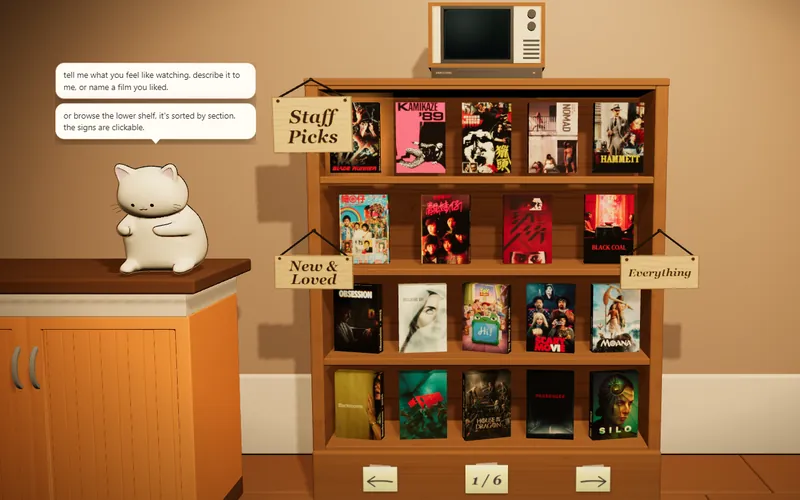
The catalogue in 3D
The film shelves have a room of their own that you can walk around in. The cat behind the counter is the AI Catbot, and they pick real films from the same catalogue when you tell them what you feel like watching. Nothing is for sale, here or in there. Go in from here and this film is already out on the counter, with more like it waiting on the shelf next to it.
How it feels
A man with an overpowering memory and synesthesia travels to Hong Kong. He meets quirky characters including an amnesiac gay bar owner. Flashbacks to his childhood in Okinawa and new human connections bring him moments of calm.
freewheelingjazzyeccentrichyper-kineticdreamlikechaoticemotionalserene
What happens
Away with Words (known also by its Chinese title 三條人, roughly translated as Three Life-stories, and its Japanese title 孔雀, translated as Peacock) is a 1999 auteur trilingual (Japanese, English, Cantonese) film by Christopher Doyle co-scripted by Doyle and Tony Rayns and starring Tadanobu Asano, Kevin Sherlock and Mavis Xu. The film, shot in a jazzy, free-wheeling style and featuring Doyle's signature hyper-kinetic, oversaturated photography and eccentric humor, focuses on a trip that Asano's character takes to Hong Kong and his encounters with off-beat personalities populating the metropolitan landscape (among them, a beer-drinking amnesiac gay bar owner portrayed by Kevin Sherlock). Another narrative thread relies on flashbacks into Asano's character's childhood in Okinawa. The protagonist suffers from overbearing excesses of his memory, mnemonic associations and synesthesia. The emerging human attachments provide an emotional center and a source of serenity to offset the rampage of the protagonist's mind and tame the lavish disarray of urban imagery. The film credits Jorge Luis Borges (presumably Funes the Memorious) and Alexander Luria for inspiration. Many aspects of Asano's character (memory excess, profound synesthesia, arranging memories visually along roads, wordplay, struggling with an onslaught of associations, comments about restaurant music and its effect on food taste, the waking-for-school scene) are directly borrowed from Luria's real life case study of Solomon Shereshevskii, The Mind of a Mnemonist. The film was screened in the Un Certain Regard section at the 1999 Cannes Film Festival. (from Wikipedia, CC BY-SA)
More like this
 Tempting Heart (1999)
 Queer Boys and Girls on the Shinkansen (2004)
 Men and Women (1999)
 Survive Style 5+ (2004)
 No Problem (1999)
 Yuwakusha (1989)
 Suk Suk (2019)
 Tenshi no Rakuen (1999)
- More like this film, on a shelf you can walk up to.It's the lit case on the top shelf.