Sometimes Happiness Sometimes Sadness... (2001)
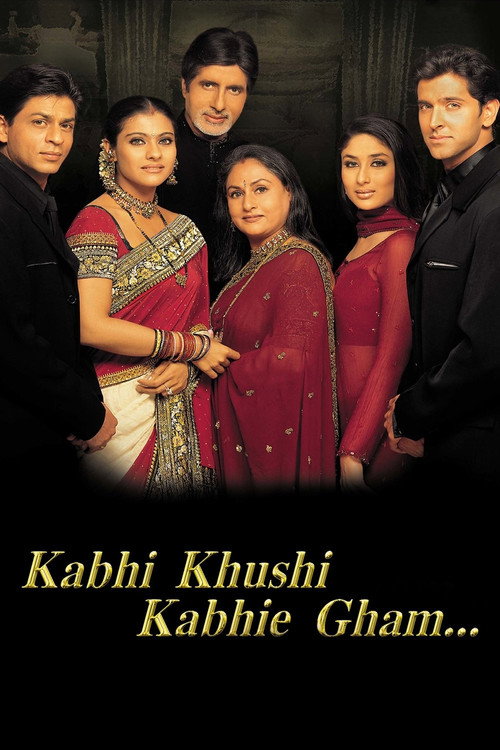
- Original title
- कभी ख़ुशी कभी ग़म
- Directed by
- Karan Johar
- Genre
- drama film, comedy film, musical film, romance film
- Country
- India
- Runtime
- 3h 30m
- Rated
- 14A
- Rating
- 7.7 of 10 from 614 voters
- Elsewhere
- IMDb

The catalogue in 3D
The film shelves have a room of their own that you can walk around in. The cat behind the counter is the AI Catbot, and they pick real films from the same catalogue when you tell them what you feel like watching. Nothing is for sale, here or in there. Go in from here and this film is already out on the counter, with more like it waiting on the shelf next to it.
How it feels
A wealthy Indian father disowns his adopted son for marrying a woman from a lower class. Years later the family tries to reunite and heal old wounds.
emotionaldramaticnostalgicfeel-goodlavishsentimentalheartfeltfamily-centric
What happens
Kabhi Khushi Kabhie Gham... (transl. Sometimes Happiness Sometimes Sadness...), also abbreviated as K3G, is a 2001 Indian Hindi-language family drama film written and directed by Karan Johar and produced by his father Yash Johar. Inspired by Yash Chopra's 1976 film Kabhi Kabhie, the core plot of the film is based on Bengali film Tumi Je Aamar (1994). It stars Amitabh Bachchan, Jaya Bachchan, Shah Rukh Khan, Kajol, Hrithik Roshan, and Kareena Kapoor, with Rani Mukerji in a extended guest appearance. The film follows a wealthy Indian family that becomes estranged when the adopted son is disowned by his father for marrying a woman of lower socio-economic status, leading to years of separation and eventual reconciliation. Johar began developing the film shortly after the release of his directorial debut Kuch Kuch Hota Hai (1998). Principal photography commenced on 16 October 2000 and took place across locations in India, the United Kingdom, and Egypt. Promoted with the tagline "It's All About Loving Your Parents", the film featured a lavish visual style and combined traditional family values with contemporary production techniques. Made at a budget of ₹30 crore (US$3.1 million)–₹40 crore (US$4.2 million), it was the most expensive Indian film at the time. The soundtrack was composed by Jatin–Lalit, Sandesh Shandilya, and Aadesh Shrivastava, with lyrics written by Sameer and Anil Pandey. Kabhie Khushi Kabhie Gham was theatrically released on 14 December 2001, and received mixed-to-positive reviews from critics who praised the performances—particularly those of Kajol, Kapoor and Jaya Bachchan—alongside its production design, music, costume design, and emotional appeal, though its extended runtime and melodramatic tone were criticized. It emerged as one of the highest grossing Indian films ever, earning ₹1.36 billion (US$29 million) worldwide. At the 47th Filmfare Awards, it won five awards, including Best Actress (Kajol Devgan) and Best Supporting Actress (Jaya Bachchan), and received several honors at the IIFA, Screen, and Zee Cine Awards. Distributed in more than 100 countries, the film held the record for the highest-grossing Indian film in overseas markets until the release of Johar’s Kabhi Alvida Naa Kehna (2006). (from Wikipedia, CC BY-SA)
More like this
 Dattak (2001)
 Yaadein (2001)
 Ek Rishtaa: The Bond of Love (2001)
 Maduve Aagona Baa (2001)
 Diggajaru (2001)
 Anandam (2001)
 Veettoda Mappillai (2001)
 Love Marriage (2001)
- More like this film, on a shelf you can walk up to.It's the lit case on the top shelf.