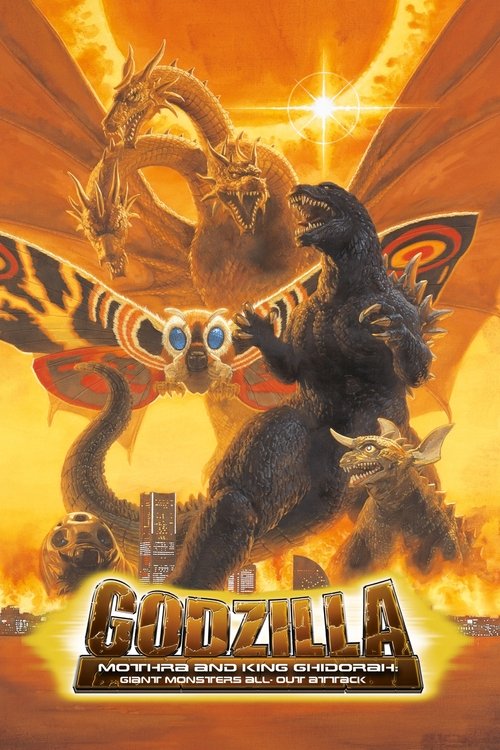
Godzilla, Mothra and King Ghidorah: Giant Monsters All-Out Attack (2001)
- Original title
- ゴジラ・モスラ・キングギドラ大怪獣総進撃
- Directed by
- Shūsuke Kaneko
- Genre
- fantasy film, science fiction film, kaiju, monster film
- Country
- Japan
- Runtime
- 1h 41m
- Rated
- NR
- Rating
- 7.5 of 10 from 286 voters
- Elsewhere
- IMDb

The catalogue in 3D
The film shelves have a room of their own that you can walk around in. The cat behind the counter is the AI Catbot, and they pick real films from the same catalogue when you tell them what you feel like watching. Nothing is for sale, here or in there. Go in from here and this film is already out on the counter, with more like it waiting on the shelf next to it.
How it feels
A reporter covers the story of three guardian monsters who must defend Japan from a vengeful Godzilla. The film follows their battle as Godzilla is possessed by the souls of those killed in the Pacific War.
vengefulsupernaturalaction-packeddarkmythicintensefast-paceddramatic
What happens
Godzilla, Mothra and King Ghidorah: Giant Monsters All-Out Attack (often abbreviated as GMK) is a 2001 Japanese kaiju film directed and co-written by Shusuke Kaneko. The 26th film in the Godzilla franchise and the third of the Millennium era, it serves as a direct sequel to Godzilla (1954) and shares a standalone continuity with the 1998 American film, ignoring the events of every other installment in the series. Chiharu Niiyama stars as a reporter covering the story of Baragon, Mothra, and King Ghidorah defending Japan from Godzilla, an onryō creature possessed by the souls of those killed during the Pacific War. The supporting cast includes Ryudo Uzaki, Masahiro Kobayashi, Shiro Sano, and Hideyo Amamoto, with Mizuho Yoshida as Godzilla, Akira Ohashi as Ghidorah, and Rie Ota as Baragon. Kaneko first pitched the idea of directing a Godzilla film to executive producer Shogo Tomiyama in 1991. Following the success of his Gamera trilogy (1995–1999) and Pyrokinesis (2000), Toho offered Kaneko the project in June 2000 with an unusual degree of creative freedom. He developed a story in which Godzilla battles three elemental guardians. At Toho's request, Varan and Anguirus were replaced with the more marketable Mothra and King Ghidorah, leaving only Baragon from the original trio. Development was nearly canceled after Godzilla vs. Megaguirus (2000) underperformed, but Tomiyama persuaded Toho to proceed. Principal photography took place from May to August 2001 on a ¥1.1 billion ($9 million) budget. Although Kaneko had hoped to direct the special effects (tokusatsu) himself as well, scheduling conflicts led to Makoto Kamiya helming them instead. Kow Otani composed the score, blending orchestral and electronic elements. Godzilla, Mothra and King Ghidorah premiered in incomplete form at the Tokyo International Film Festival on November 3, 2001. Toho released the completed film throughout Japan on December 15, as a double feature with Hamtaro: Adventures in Ham-Ham Land. The double bill earned ¥2.71 billion (over $20 million), tying for the third-highest-grossing Japanese film during 2002. Godzilla, Mothra and King Ghidorah received generally positive reviews from critics and is widely regarded as one of the best entries in the Godzilla franchise and ultimately the most critically and commercially successful film in the Millennium series. Critics initially praised its direction, characters, and special effects, but were divided on the darker tone, monster reimaginings, and third act. Its performance ensured the franchise's continuation, leading to Masaaki Tezuka's Godzilla Against Mechagodzilla (2002), set in a different continuity. (from Wikipedia, CC BY-SA)
More like this
 Godzilla 2000 (1999)
 Godzilla vs. Hedorah (1971)
 Godzilla vs. Destoroyah (1995)
 Spirited Away (2001)
 Godzilla Minus One (2023)
 Godzilla: Tokyo S.O.S. (2003)
 Gamera 2: Attack of Legion (1996)
 Cowboy Bebop: The Movie (2001)
- More like this film, on a shelf you can walk up to.It's the lit case on the top shelf.