Kursk: A Submarine in Troubled Waters (2004)
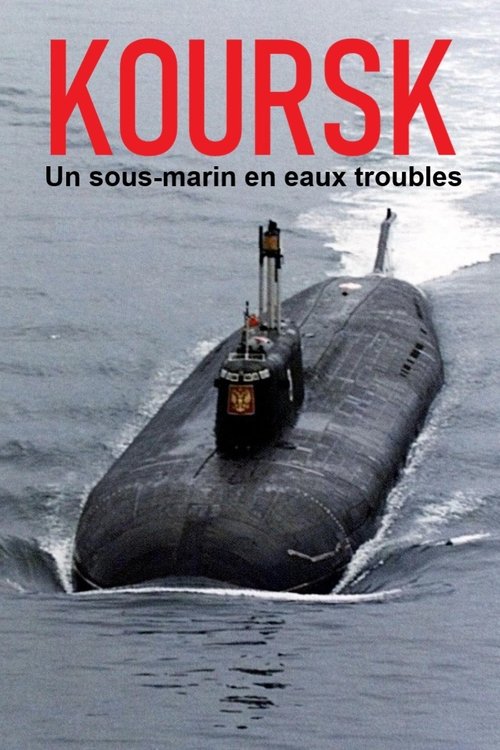
- Original title
- Koursk : Un sous-marin en eaux troubles
- Directed by
- Jean-Michel Carré
- Genre
- documentary film
- Country
- France
- Runtime
- 1h 30m
- Rating
- 6.2 of 10 from 4 voters
- Elsewhere
- IMDb

The catalogue in 3D
The film shelves have a room of their own that you can walk around in. The cat behind the counter is the AI Catbot, and they pick real films from the same catalogue when you tell them what you feel like watching. Nothing is for sale, here or in there. Go in from here and this film is already out on the counter, with more like it waiting on the shelf next to it.
How it feels
This documentary examines the sinking of the Russian nuclear submarine Kursk in 2000. It details the accident, the failed rescue attempts, and the official response that was criticized as slow and misleading.
somberfactualmethodicaltensebleakinformationalsobering
What happens
The Russian nuclear submarine K-141 Kursk sank in an accident on 12 August 2000 in the Barents Sea, with the death of all 118 personnel on board. The submarine, which was of the Project 949A-class (Oscar II class), was taking part in the first major Russian naval exercise in more than 10 years. The crews of nearby ships felt an initial explosion and a second, much larger explosion, but the Russian Navy did not realise that an accident had occurred and did not initiate a search for the vessel for over six hours. The submarine's emergency rescue buoy had been intentionally disabled during an earlier mission; it took more than 16 hours to locate the submarine, which rested on the ocean floor at a depth of 108 metres (354 ft). Over four days, the Russian Navy repeatedly failed in its attempts to attach four different diving bells and submersibles to the escape hatch of the submarine. Its response was criticised as slow and inept. Officials misled and manipulated the public and news media, and refused help from other countries' ships nearby. President Vladimir Putin initially continued his vacation at a seaside resort in Sochi and authorised the Russian Navy to accept British and Norwegian assistance only after five days had passed. Two days later, British and Norwegian divers finally opened a hatch to the escape trunk in the boat's flooded ninth compartment, but found no survivors. An official investigation concluded that when the crew loaded a dummy 65-76 "Kit" torpedo, a faulty weld in its casing leaked high-test peroxide (HTP) inside the torpedo tube, initiating a catalytic explosion. The torpedo manufacturer challenged this hypothesis, insisting that its design would prevent the kind of event described. The explosion blew off both the inner and outer tube doors, ignited a fire, destroyed the bulkhead between the first and second compartments, damaged the control room in the second compartment, and incapacitated or killed the torpedo room and control-room crew. Two minutes and fifteen seconds after the first explosion, another five to seven torpedo warheads exploded. They tore a large hole in the hull, collapsed the bulkheads between the first three compartments and all the decks, destroyed compartment four, and killed everyone still alive forward of the sixth compartment. The nuclear reactors shut down without melting down. Analysts concluded that 23 sailors took refuge in the small ninth compartment and survived for more than six hours. When oxygen ran low, they attempted to replace a potassium superoxide chemical oxygen cartridge, but it fell into the oily seawater and exploded on contact. The resulting fire killed several crew members and triggered a flash fire that consumed the remaining oxygen, asphyxiating the remaining survivors. The Dutch company Mammoet was awarded a salvage contract in May 2001. Within a three-month period, the company and its subcontractors designed, fabricated, installed, and commissioned over 3,000 t (3,000 long tons; 3,300 short tons) of custom-made equipment. A barge was modified and loaded with the equipment, arriving in the Barents Sea in August. On 3 October 2001, some 14 months after the accident, the hull was raised from the seabed floor and hauled to a dry dock. The salvage team recovered all but the bow, including the remains of 115 sailors, who were later buried in Russia. The government of Russia and the Russian Navy were intensely criticised over the incident and their responses. A four-page summary of a 133-volume investigation stated "stunning breaches of discipline, shoddy, obsolete and poorly maintained equipment", and "negligence, incompetence, and mismanagement". It stated that the rescue operation was unjustifiably delayed and that the Russian Navy was completely unprepared to respond to the disaster. (from Wikipedia, CC BY-SA)
More like this
 The Raising of the Kursk (2002)
 Kursk (2018)
 La bataille de Tchernobyl (2006)
 U 864
U 864 72 Meters (2004)
 Night and Fog (1956)
 Cold War Submarine Adventures: K-19 - Doomsday Submarine (2002)
 1/3 des yeux (2004)
- More like this film, on a shelf you can walk up to.It's the lit case on the top shelf.